
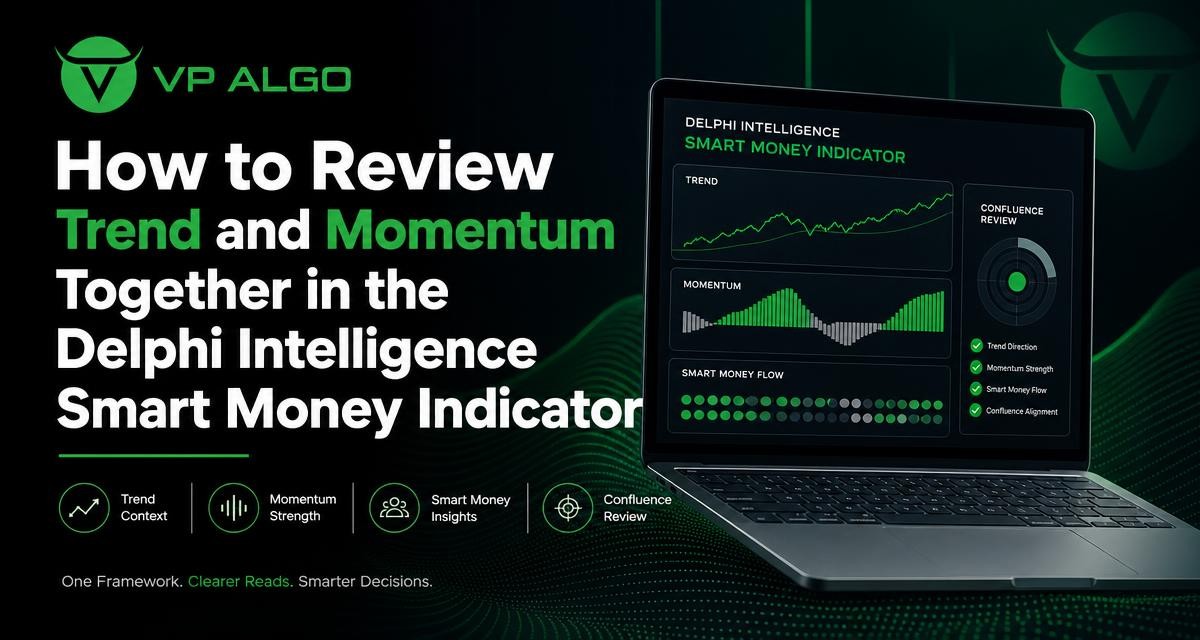
Using a trend indicator for TradingView alongside a momentum indicator can give traders a more structured way to review market conditions. The Delphi Intelligence Smart Money Indicator brings trend analysis, momentum evaluation, market structure, institutional activity, multi-timeframe trend assessment and smart money concepts into one analytical framework. The goal is not to turn several observations into a guaranteed setup, but to help traders examine whether different parts of the market picture are telling a consistent story.
Why review trend and momentum together?
Trend and momentum answer different questions. Trend analysis focuses on direction and structure: is the market generally moving upward, downward or sideways? Momentum analysis focuses on the strength and persistence of that movement: is buying or selling pressure building, fading or becoming uncertain?
Looking at only one of these areas can create an incomplete view. A market may be moving upward while momentum is weakening. Conversely, momentum may increase during a short move against a broader trend. Reviewing both helps separate direction from immediate movement and encourages a more deliberate interpretation of the chart.
| Review area | Question to ask | What it can add to the analysis |
|---|---|---|
| Trend | What direction is the market currently showing? | A broader directional context |
| Momentum | How strong or persistent is the current movement? | Information about participation and movement strength |
| Market structure | How are highs, lows and structural changes developing? | Context for continuation or possible change |
| Institutional activity | What does the available activity analysis suggest about market participation? | An additional perspective on flow and interest |
| Multi-timeframe trend | Does the direction remain consistent across selected timeframes? | Context for separating wider conditions from short-term noise |
What the Delphi Intelligence Smart Money Indicator contributes
The Delphi Intelligence Smart Money Indicator is designed to combine several analytical perspectives rather than isolate trend or momentum from the rest of the chart. Its stated features include trend analysis, momentum signals, market structure, institutional flow monitoring, multi-timeframe trend assessment and smart money analysis.
That combination can make the review process more organised. Instead of treating a single signal as the complete decision, a trader can examine how trend direction relates to momentum, whether the market structure supports the same interpretation and whether the broader timeframe provides useful context. The indicator is intended to assist trading decisions and education, not to provide financial advice or remove the need for independent analysis.
A step-by-step trend and momentum review process
1. Start with the wider trend
Begin with the trend view before focusing on a particular candle or recent movement. Ask whether the broader chart appears to be showing upward, downward or less directional conditions. The purpose of this first step is to establish a working context, not to predict what the market must do next.
Multi-timeframe trend assessment can help with this distinction. A shorter timeframe may show a temporary move that differs from the wider trend. Recording the direction seen on more than one timeframe can prevent a trader from treating a brief fluctuation as a complete market reversal.
2. Examine momentum separately
After identifying the working trend, review momentum on its own. Consider whether the current movement appears to be strengthening, slowing or changing character. Avoid automatically interpreting stronger momentum as a buy or sell instruction. Momentum is a description of movement conditions; it does not, by itself, explain the full market structure or determine suitable risk.
A useful question is whether momentum supports the direction identified in the first step. For example, trend and momentum may point in the same direction, or the trend may remain upward while momentum becomes less supportive. These are different observations and should be recorded as such.
3. Check market structure
Market structure adds a framework for interpreting movement over time. Review how relevant highs and lows are developing and whether the current price action appears to maintain or challenge the existing structure. This step is useful because a momentum change can occur inside an established trend without changing the wider structure.
The Delphi indicator includes market structure analysis as part of its broader smart money approach. Use that information to ask whether the trend and momentum observations are consistent with the structure shown on the chart. If they disagree, the disagreement is itself important context rather than something to ignore.
4. Review institutional activity and smart money conditions
The indicator also includes features related to institutional activity and smart money analysis. These elements provide another lens for reviewing market participation and potential areas of interest. They should be considered alongside, rather than substituted for, trend, momentum and structure.
When activity analysis appears to support a directional view, treat it as an additional point for review. It does not establish that a particular participant has taken a position, nor does it guarantee that price will continue in the same direction. The most useful interpretation is generally one that remains consistent with the chart’s wider evidence.
5. Compare the timeframes
Bring the observations together by comparing the selected timeframes. A higher timeframe can provide wider directional context, while a lower timeframe may reveal short-term momentum changes or structural details. Neither view should automatically override the other; they answer different questions.
For example, a lower timeframe may show improving momentum while the higher timeframe remains neutral or downward. That combination may describe a short-term recovery inside a broader uncertain condition. The correct response is not to force agreement, but to label the conditions accurately and decide whether the situation fits the trader’s own plan.

How to interpret agreement and disagreement
When trend and momentum agree
Agreement means the directional trend and current momentum are broadly pointing in the same direction. This can make the chart easier to organise because the immediate movement is not obviously contradicting the wider direction. Even so, agreement does not guarantee continuation or define an entry, exit or position size.
Use agreement as a reason to continue the review. Check market structure, timeframe context and the available institutional activity analysis before drawing a conclusion. Also consider whether the movement is extended, unclear or developing in a way that does not match the trader’s rules.
When trend and momentum disagree
Disagreement is common and can be informative. A trend may remain positive while momentum weakens, suggesting that the current move deserves closer attention. A downward trend may also experience a temporary increase in upward momentum without establishing a lasting reversal.
Rather than treating disagreement as a direct signal, use it to slow down the review. Look for confirmation in market structure and compare the observation across timeframes. If the evidence remains mixed, describing the market as mixed may be more disciplined than forcing a directional label.
A practical review checklist
A repeatable checklist can reduce the temptation to focus on whichever signal appears most attractive. The following sequence can be adapted to a trader’s own method and timeframe selection:
- Identify the broader trend shown by the indicator and chart.
- Record whether momentum is strengthening, weakening or unclear.
- Review relevant market structure and any visible structural change.
- Compare the trend across the selected timeframes.
- Examine institutional activity and smart money analysis as supporting context.
- Note areas where the evidence agrees and where it conflicts.
- Check the result against an independent trading plan and risk process.
- Decide whether the conditions are clear enough for further analysis or better treated as uncertain.
This process is deliberately analytical rather than mechanical. It does not turn the Delphi Intelligence Smart Money Indicator into an automatic decision-maker. It gives the trader a consistent way to describe the chart before considering any action.
Common mistakes when combining trend and momentum
Using the latest movement as the entire trend
A recent move can attract attention because it is visually prominent, but it may not represent the wider direction. Compare shorter-term movement with multi-timeframe trend information before assigning it too much importance.
Treating momentum as a standalone instruction
Momentum can change quickly. Reading an increase or decrease as a complete buy or sell decision removes the structural context that makes the observation meaningful. Review it together with direction, market structure and the trader’s own rules.
Ignoring conflicting evidence
Not every feature will point in the same direction at every moment. Conflicting information is a normal part of market analysis. Documenting the conflict can be more useful than selecting only the most convenient signal.
Assuming more features mean more certainty
A combined indicator can organise several forms of information, but additional features do not eliminate uncertainty. Trend, momentum, structure and activity analysis remain interpretations of market conditions. They should be used with appropriate risk awareness and independent judgement.
Using the indicator as part of a wider TradingView workflow
The Delphi Intelligence Smart Money Indicator can serve as a central review tool within a TradingView charting routine. A trader may begin by defining the timeframe and market context, then use the indicator to examine trend, momentum, structure, institutional activity and smart money conditions in a consistent order.
The final interpretation should still be compared with the trader’s own rules for timing, risk, trade management and invalidation. The indicator does not replace those rules, and it should not be presented as a guarantee of a particular outcome. Its practical value comes from helping users organise observations that might otherwise be reviewed separately.
Who may benefit from this review approach?
This approach may be useful for TradingView users who want to bring several forms of technical and smart money analysis into one review process. Beginners may benefit from the clear separation between trend, momentum and structure. More experienced traders may use the same framework to make their existing chart review more consistent.
The method is not tied to one claimed strategy or promised result. Its purpose is to improve the quality of questions asked during analysis: What is the wider direction? Is momentum supporting it? Does market structure agree? Are the timeframes aligned? What remains uncertain?
Final perspective
Reviewing a trend indicator for TradingView together with momentum can provide a clearer way to organise chart information, especially when the review also includes market structure, institutional activity, smart money conditions and multiple timeframes. The Delphi Intelligence Smart Money Indicator is built around these stated analytical features.
The most responsible use is contextual. Treat agreement as supporting information, disagreement as information that needs further examination and every indicator reading as one part of a wider decision process. This keeps the focus on disciplined analysis rather than on expecting any combination of features to guarantee a setup or trading result.
Frequently asked questions
What is a trend indicator for TradingView?
A trend indicator for TradingView is a charting tool used to help assess the market’s current directional conditions. It can support analysis, but it does not guarantee that a trend will continue.
How does a momentum indicator for TradingView differ from a trend indicator?
A trend indicator focuses mainly on direction, while a momentum indicator focuses on the strength or persistence of recent movement. Reviewing both can provide more context than relying on either observation alone.
What does the Delphi Intelligence Smart Money Indicator analyse?
Its stated features include trend analysis, momentum signals, market structure, institutional activity, multi-timeframe trend assessment and smart money analysis.
Should trend and momentum always agree before analysis continues?
No. Disagreement can show that conditions are mixed or changing. It should encourage closer review of market structure and timeframe context rather than being treated as an automatic trading signal.
Does combining trend and momentum guarantee a trading setup?
No. The combination can help organise observations, but it cannot guarantee a setup, profitable result or specific future market behaviour.
Can beginners use this review process?
Yes. Beginners can use the sequence as a learning framework, provided they understand that the indicator supports analysis and does not replace independent research, risk management or financial advice.


Recent Comments