
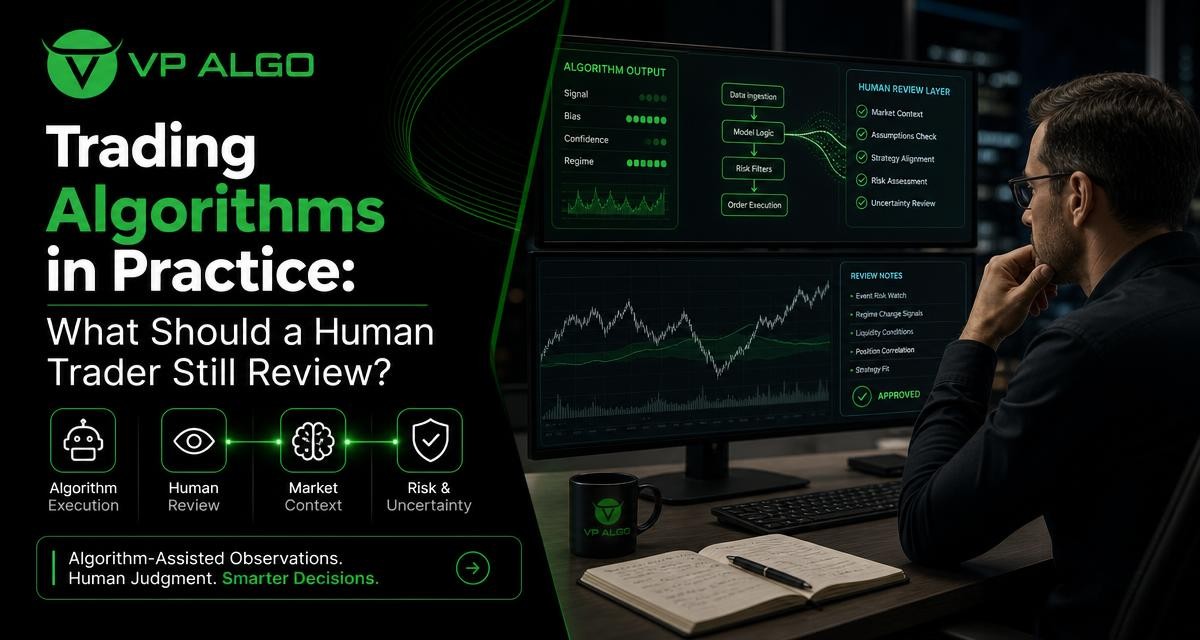
Trading algorithms can help traders organize market information, identify recurring conditions and review potential setups more consistently. They can be useful for examining trend, momentum, market structure and other technical observations, but they do not remove the need for judgment. A human trader still has to decide whether the information is relevant, whether the underlying assumptions make sense and how much uncertainty is present before treating an observation as part of a trading plan.
What trading algorithms can do well
At a practical level, trading algorithms are sets of rules that process market data and produce an output. That output might be a trend reading, a momentum condition, a structural change, a highlighted zone or another type of chart-based observation. The value is not that an algorithm knows what will happen next. Its value is that it can apply a defined process to information that would otherwise take time to review manually.
This makes algorithm-assisted analysis useful for traders who want a repeatable starting point. A TradingView indicator, for example, can help present several technical observations in one workspace. Instead of switching between unrelated charts or relying on memory, the trader can begin with a structured view and then investigate the details behind it.
| Task | Where an algorithm can assist | What the trader should still review |
|---|---|---|
| Trend analysis | Highlighting directional conditions or changes in trend | Whether the trend is clear, mature, conflicting or relevant to the chosen timeframe |
| Momentum evaluation | Identifying stronger or weaker movement | Whether momentum is supported by structure, sustainable or already extended |
| Market structure | Marking possible breaks, swings or structural areas | Whether the markings fit the broader chart and the trader’s interpretation |
| Multi-timeframe review | Presenting observations across more than one timeframe | Whether the timeframes agree and whether the higher-timeframe context changes the conclusion |
| Setup screening | Filtering charts or conditions according to defined rules | Whether the setup remains suitable after news, volatility and execution considerations are considered |
Why algorithmic observations are not complete decisions
An algorithm works from the data and rules available to it. It does not possess the full context that a trader may need to consider. A chart can show a strong move, for instance, while the trader still needs to ask whether the move is occurring in a broader range, near a significant level or after an unusually extended run.
Even a well-organized indicator output is an observation rather than a command. The same technical condition can have a different meaning depending on timeframe, volatility and market environment. A human review helps prevent a trader from treating every highlighted condition as equally important.
Signals are conditional, not certain
Many trading strategies use conditions such as trend direction, momentum, market structure or a combination of signals. These conditions can support a scenario, but they cannot establish certainty. A bullish observation does not guarantee continuation, and a bearish observation does not guarantee a decline.
The useful question is therefore not simply, “Is there a signal?” A better question is, “What does this signal suggest, what would weaken that interpretation, and what information is still missing?” That change in questioning keeps the trader involved in the analysis instead of outsourcing the decision to a display on the chart.
The first human review: market context
Context is the surrounding information that gives an observation meaning. It includes the broader direction of the market, the timeframe being studied, the recent price behavior and the location of the current price within the chart. An algorithm may identify a condition correctly while the trader still needs to determine whether it matters in the current setting.
Review the higher-timeframe picture
A lower-timeframe setup can look attractive in isolation but conflict with a broader trend or structure. Reviewing a higher timeframe can help the trader see whether the proposed idea is aligned with a wider movement, occurring inside consolidation or reacting against a larger directional bias.
This does not mean that every decision must follow the highest timeframe. It means that the trader should know what the broader chart is doing before placing too much weight on a more detailed observation. Multi-timeframe analysis is most useful when it clarifies the relationship between the immediate setup and the larger market environment.
Consider price location
Market structure is not only about whether price has moved upward or downward. Location also matters. A condition that appears near the middle of a broad range may offer a different interpretation from one that appears near a well-defined boundary or after a rapid directional move.
A market structure indicator can help draw attention to possible changes, but the trader should inspect the surrounding swings and levels. Human review is needed to decide whether a marked event is meaningful or simply a short-term fluctuation within a larger pattern.
The second human review: assumptions behind the output
Every algorithm is built on assumptions. These may relate to how trend is defined, how momentum is measured, how a structural change is recognized or how multiple observations are combined. A trader does not need to be a software developer to review these assumptions, but should understand what the output represents before using it.
Ask what the indicator is measuring
A label such as trend, momentum or institutional activity can be useful, but it should not be interpreted more broadly than the underlying method supports. A chart-based indication of institutional flow, for example, should be treated as an analytical representation rather than direct access to every institutional decision or position.
Similarly, smart money concepts can provide a framework for studying market behavior, liquidity and structure. They should not be treated as proof that a particular group of market participants will act in a predicted way. The trader remains responsible for understanding the limits of the concept and the way it is presented by the tool.
Check for lag and changing conditions
Some calculations depend on previous price data. That can make an output more stable, but it can also mean that the observation responds after a move has already begun. Other methods may react quickly and produce more frequent changes. Neither characteristic is automatically better; the important point is to understand the trade-off.
Market conditions also change. A method that appears clear during a sustained directional move may be less easy to interpret during a sideways or highly erratic period. Human review helps the trader recognize when a familiar tool is being applied outside the conditions in which its observations are most useful.
The third human review: uncertainty and alternative explanations
Good analysis does not stop at the first interpretation. If an algorithm highlights a possible bullish setup, the trader should consider what else could explain the same movement. It may be a continuation, a temporary reaction, a failed breakout or a movement within a wider range. These alternatives do not need to be predicted perfectly, but they should be acknowledged.
One practical approach is to write down a primary scenario and at least one invalidation condition. The primary scenario describes what the trader thinks may happen. The invalidation condition describes what would make that interpretation less credible. This creates a decision framework without pretending that the market is certain.
An algorithm can organize the evidence. The trader must decide how much confidence the evidence deserves.
Separate observation from interpretation
“Momentum is increasing” is an observation. “Price will continue higher” is an interpretation. Keeping these statements separate makes it easier to review the reasoning. The first may be supported by the indicator’s rules; the second requires additional judgment about structure, location, volatility and risk.
This distinction is especially important when several outputs appear to agree. Multiple signals can describe related aspects of the same price movement rather than provide independent confirmation. A trader should ask whether the evidence is genuinely diverse or whether several labels are reflecting one underlying condition.
How a human trader can review an algorithm-assisted setup
A repeatable review process can make trading algorithms more useful without turning them into automatic decision-makers. The following sequence is a practical framework for reviewing a possible setup on a TradingView chart or similar workspace.
- Define the market and timeframe. Be clear about the chart being reviewed and the type of decision under consideration. An observation on one timeframe should not be treated as though it automatically applies to every timeframe.
- Read the broader structure. Review the larger directional condition, important swings and whether price is trending, ranging or transitioning.
- Identify the algorithmic observation. Record what the indicator is showing without immediately converting it into a buy or sell conclusion.
- Look for agreement and conflict. Compare trend, momentum and structure. Conflicting readings are information, not necessarily a reason to force a decision.
- Review the surrounding context. Consider recent movement, price location and whether the market appears unusually extended or unstable.
- State the assumption. Write down why the observation might matter and what must remain true for the idea to stay valid.
- Define invalidation before acting. Decide what evidence would weaken or cancel the idea. This is different from waiting until after the market moves against the position.
- Make a deliberate decision. The result may be to proceed according to an existing plan, wait for more information or take no trade. A no-action decision is still a decision.
Using a market intelligence indicator without outsourcing judgment
VP ALGO TRADING develops trading indicators and algorithmic tools for TradingView, including the AKMelytics – Market Intelligence Indicator identified for this topic. The company’s broader indicator offering is designed to help traders examine areas such as trend analysis, momentum, market structure, institutional activity, multi-timeframe trend assessment and smart money analysis.
Used appropriately, a market intelligence indicator can serve as a structured review aid. It may help a trader bring several observations together before considering a setup. The trader should still verify what each observation means, compare it with the chart and apply a personal process for uncertainty and risk. The tool is not a substitute for financial advice or for the trader’s own decision-making.
Build a review journal
A journal can show whether the trader is using the indicator consistently. Useful notes include the market context, the algorithmic observations, the trader’s interpretation, the reason for taking or avoiding a setup and what later information changed the view.
The purpose is not to prove that an indicator is always right or wrong. It is to identify how the trader responds to the tool. For example, a journal may reveal that the trader repeatedly ignores higher-timeframe conflict, treats every momentum change as a reversal or enters after a move has already become extended.
Common mistakes when using trading algorithms
Treating every signal as an instruction
An alert or highlighted condition can attract attention, but attention is not confirmation. Treating every output as an instruction encourages mechanical reactions and can cause the trader to overlook context. A better approach is to use the output as a prompt for further review.
Adding more indicators instead of improving the process
More tools do not automatically create better analysis. If several indicators measure similar aspects of price, adding them may create the appearance of agreement without adding much independent information. A smaller set of clearly understood observations can be easier to review than a crowded chart.
Ignoring a changing market environment
A trading strategy may behave differently as conditions change. Trend-following observations, for example, may be easier to interpret in a directional market than in a narrow range. The trader should regularly ask whether the current environment fits the assumptions behind the chosen process.
Confusing historical evidence with a future promise
Charts and past observations can help a trader study how a method behaved in earlier conditions. They cannot guarantee what will happen next. Past performance does not predict or guarantee future results, and no indicator eliminates trading losses or uncertainty.
A practical division of responsibility
The most useful division is straightforward: the algorithm helps organize and process defined information, while the human trader supplies context, interpretation and accountability. The algorithm can make a repeated observation easier to perform. The trader must decide whether the observation is relevant to the current market and consistent with a personal plan.
| Algorithm-assisted role | Human review role |
|---|---|
| Process chart data according to programmed rules | Understand the limits of those rules |
| Highlight possible trend or momentum conditions | Assess whether the condition is significant in context |
| Present structural or smart money observations | Check whether the interpretation fits the broader chart |
| Support a repeatable screening process | Decide whether the setup belongs in the trader’s plan |
| Reduce some manual chart-review work | Manage uncertainty, expectations and responsibility |
This division avoids two extremes. The first is dismissing algorithmic tools as unnecessary because human judgment matters. The second is treating an algorithm as an authority that removes the need to think. Trading algorithms are most useful when they improve the quality and consistency of the questions a trader asks.
Final checklist before relying on an algorithmic observation
- Do I understand what the output represents?
- What timeframe and market context does it describe?
- Does the broader structure support or conflict with the observation?
- Am I separating what the chart shows from what I think may happen?
- What alternative explanation could fit the same price movement?
- What would invalidate the current interpretation?
- Am I following a defined trading plan rather than reacting to a label?
These questions keep the trader engaged with the reasoning process. They also make it easier to evaluate whether a tool is genuinely helping or simply increasing the amount of information on the screen.
Frequently asked questions
What are trading algorithms used for?
Trading algorithms can process market data according to defined rules and present observations such as trend, momentum or market structure conditions. They can support chart review but do not guarantee a particular market outcome.
Can trading algorithms make decisions without a human trader?
Some systems may be designed for automated execution, but an algorithm-assisted indicator is not the same as a fully autonomous decision process. Human review remains useful for context, assumptions, uncertainty and alignment with a trading plan.
Why should traders review market context?
The same technical condition can have different meanings in a trend, a range or a volatile transition. Context helps the trader decide whether an algorithmic observation is relevant and how much weight it deserves.
What should I check when using a TradingView indicator?
Review what the indicator measures, which timeframe it describes, how it relates to broader structure and whether its output conflicts with other important chart information. Avoid treating every highlighted condition as an automatic trade instruction.
Are smart money concepts a guarantee of institutional activity?
No. Smart money concepts can provide a framework for studying market behavior and structure, but an indicator’s representation should not be treated as direct proof of every institutional position or decision.
Can an indicator eliminate trading losses?
No. Indicators and trading algorithms cannot eliminate market uncertainty or trading losses. They are tools for analysis and decision support, not guarantees of profitable results.
What is the best role for a human trader?
The human trader should review context, understand assumptions, consider alternative explanations, define invalidation and decide whether an observation fits the trading plan. The trader remains responsible for the final decision.


Recent Comments