
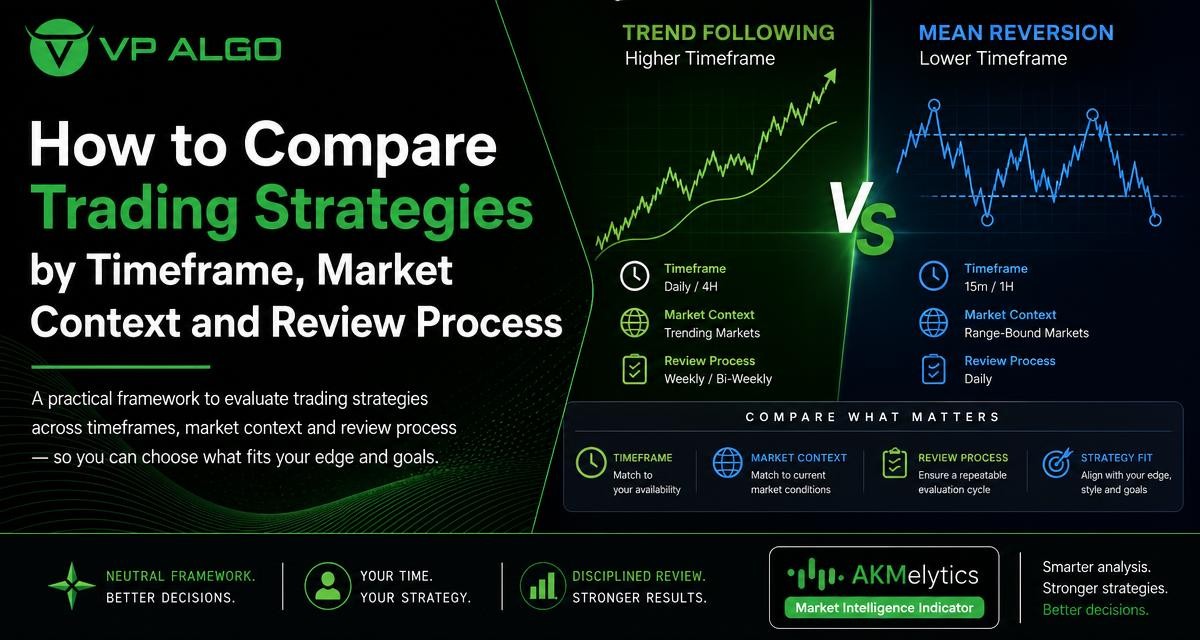
Searching for the best trading strategy often leads to the wrong question. A strategy that suits a trader with limited screen time may be unsuitable for someone who monitors short-term price movements, while an approach that works well in a strong trend may be poorly matched to a range-bound market. A more useful comparison considers timeframe, market context, analysis requirements and the process used to review decisions. This framework can help traders assess different approaches without assuming that one method is universally superior.
Why there is no single best trading strategy
Trading strategies are designed around different assumptions. Some seek to follow an established trend, some look for price reversals, and others focus on breakouts, momentum or changes in market structure. Each approach may require different information, different levels of attention and different ways of managing uncertainty.
The same strategy can also behave differently as market conditions change. A directional market may provide clearer opportunities for trend-following analysis, while a sideways market can produce repeated false signals for the same approach. This does not automatically make the strategy good or bad. It shows why the comparison should include the conditions in which the method is intended to operate and the conditions in which it may become less suitable.
Start with the trading timeframe
Timeframe affects how often a trader must analyse charts, how much market noise appears in price movement and how long a position may remain open. It also influences the type of review that is practical. A trader who studies higher-timeframe charts may focus on broad direction and major structure, whereas a short-term trader may need to assess intraday momentum and rapid changes in price behaviour.
Shorter timeframes
Shorter timeframes can offer more frequent observations, but they also demand a disciplined process. Small price movements can create signals that do not represent the broader market direction. A comparison of short-term strategies should therefore examine how the method handles noise, how clearly its entry and exit conditions are defined, and whether the trader has enough time to monitor the relevant charts.
Higher timeframes
Higher timeframes may make broader trends and structural levels easier to study. However, opportunities can take longer to develop, and a trader may need patience while waiting for a setup to meet the planned conditions. Reviewing a higher-timeframe strategy should include the time required to hold a position, the frequency of decisions and the trader’s ability to remain consistent during periods with limited activity.
| Timeframe focus | Useful questions | Common review emphasis |
|---|---|---|
| Short term | Can the trader monitor changes consistently? | Noise, execution discipline and rapid momentum shifts |
| Medium term | Does the approach balance activity with patience? | Trend direction, structure and confirmation |
| Higher timeframe | Can the trader wait for fewer, more developed setups? | Major structure, broader trend and position duration |
There is no automatically superior timeframe. The appropriate choice depends on the trader’s schedule, experience, objectives and ability to follow a repeatable process. Comparing two strategies on different timeframes without recognising this difference can produce an unfair conclusion.
Compare strategies by market context
Market context describes the conditions surrounding a potential setup. It includes direction, momentum, volatility, market structure and the behaviour of price near important areas. A strategy should be assessed not only by the signal it produces, but also by whether the wider context supports the type of decision it is designed to guide.
Trending conditions
In a directional market, traders may give greater attention to trend analysis, continuation patterns and momentum. A trend-oriented strategy might seek entries that align with the established direction rather than attempting to predict every reversal. When comparing such approaches, ask how the strategy defines a trend and whether it distinguishes a developing move from a temporary price reaction.
Range-bound conditions
When price moves between identifiable boundaries, a trend-following method may generate conflicting signals. A range-focused approach may instead study reactions near the upper and lower parts of the range. The comparison should examine how the strategy identifies a range, how it responds when price breaks out and whether it has a clear method for avoiding assumptions that the range will continue indefinitely.
Breakout and transition conditions
Some strategies focus on changes from one market condition to another. These approaches may study price moving beyond a recognised structure, changes in momentum or evidence that participation is increasing. They can be useful to compare with trend-following or range-based methods, but the review must account for false breakouts and situations where price briefly moves beyond a level before returning.
Unclear or mixed conditions
Not every chart presents a clean trend, range or breakout. Mixed conditions are an important part of a realistic comparison because a strategy may be most vulnerable when signals conflict. A strong review process should allow the trader to record that conditions are unclear rather than forcing a trade decision from incomplete evidence.
Evaluate what each strategy actually analyses
Two strategies may use similar language while analysing different information. One may be primarily based on price patterns, another on momentum, and another on market structure or institutional activity. The goal is not to collect the largest number of indicators. It is to understand what each tool contributes and whether the information is genuinely distinct.
Trend and momentum
Trend analysis asks whether price is moving with a recognisable directional bias. Momentum analysis considers the strength or persistence of that movement. These concepts can support one another, but they are not identical. A strategy that uses both should explain how conflicting readings are handled instead of treating every additional signal as automatic confirmation.
Market structure
Market structure focuses on how price forms and breaks significant highs, lows, ranges or other levels. It can provide a framework for understanding whether a market is continuing, consolidating or changing direction. When comparing strategies, consider whether structure is defined consistently and whether the trader can identify the same conditions during a later review.
Institutional activity and smart money concepts
Some trading approaches include institutional activity or smart money concepts as part of their market interpretation. These ideas should be used as analytical inputs rather than treated as proof of a future price outcome. A useful comparison asks how the information is defined, how it fits with trend and momentum analysis, and whether it improves the clarity of the trader’s decision process.
Indicators and visual tools
A TradingView indicator can help organise information on a chart, but it does not replace a strategy. The trader still needs rules for interpreting signals, checking the surrounding context and deciding when conditions are not suitable. Tools such as VP ALGO TRADING’s AKMelytics – Market Intelligence Indicator can be considered within this broader workflow: not as a guarantee of a particular result, but as part of a structured way to examine market information.
Build a fair strategy comparison
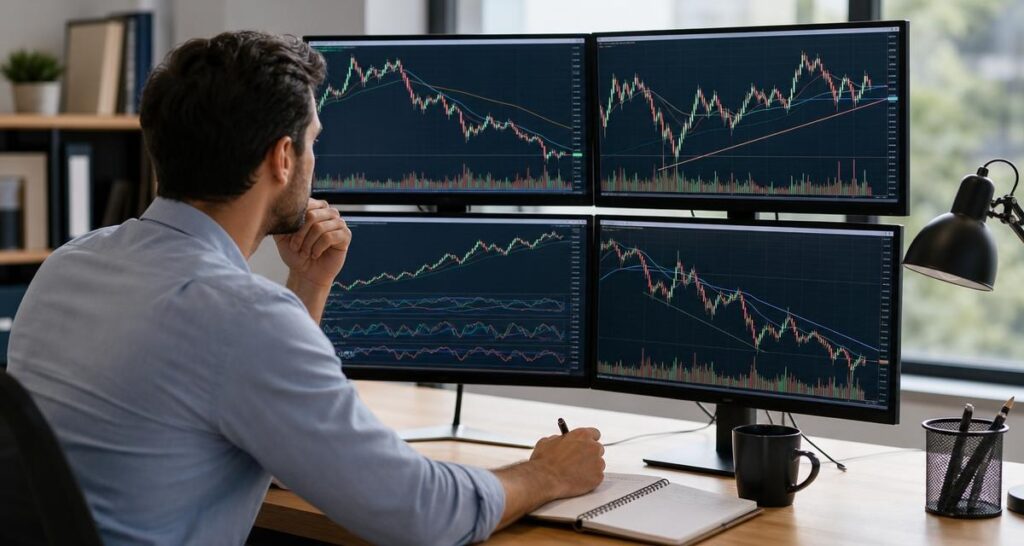
Comparisons become unreliable when each strategy is judged using different standards. For example, one method may be tested only during clear trends while another is reviewed across both trends and ranges. A fair process defines the comparison criteria before reviewing individual examples.
The following questions can provide a practical starting point:
- What market condition is the strategy intended to analyse?
- Which timeframe is used, and how much attention does it require?
- What information creates a valid setup?
- What would invalidate the setup before a decision is made?
- How does the approach respond to conflicting signals?
- What does the trader record after each reviewed example?
- How will the strategy be assessed when conditions are unclear?
It is also useful to separate the quality of the process from the outcome of one individual trade. A favourable result does not automatically prove that the method was applied correctly, and an unfavourable result does not by itself prove that the strategy is useless. Reviewing the reasoning behind the decision can provide more useful information than focusing only on whether price moved in the expected direction.
Use a structured review process
A written review can reduce hindsight bias and make different trading strategies easier to compare. Before analysing a chart, record the strategy being considered, the timeframe and the apparent market context. Then document the information that supported the setup and the information that argued against it.
Before the decision
Describe the market without making the conclusion overly specific. For example, note whether price appears directional, range-bound or unsettled; whether momentum supports the observed move; and whether the current structure is intact or showing signs of change. This creates a consistent starting point for each strategy.
During the decision
Record the conditions that must be present before the strategy is considered valid. Include the reason for waiting, the evidence that would cancel the idea and any uncertainty that remains. This helps distinguish a rules-based decision from one made simply because the chart appears active.
After the decision
Review whether the strategy was followed as written. Note which conditions were present, which were absent and whether the market context changed. The review should not be rewritten solely around the eventual price movement. Instead, assess whether the method was applied consistently and whether the original rules were clear enough to guide the decision.
| Review area | What to record | Why it matters |
|---|---|---|
| Context | Trend, range, transition or unclear conditions | Shows whether the strategy was used in a suitable environment |
| Evidence | Trend, momentum, structure or other defined inputs | Clarifies the reasoning behind the setup |
| Rules | Required conditions and invalidation points | Separates planned decisions from improvised ones |
| Execution review | Whether the process was followed | Highlights discipline and rule clarity |
| Context change | What changed after the initial assessment | Shows where the strategy may need caution |
Compare analysis needs with available time
A strategy should fit the trader’s real routine, not an imagined schedule. Someone who cannot monitor charts regularly may find an approach requiring frequent short-term decisions difficult to apply consistently. A trader with more time may still prefer a higher-timeframe process if it produces clearer analysis and fewer decisions.
Consider the full workload, including preparation, chart review, documentation and ongoing evaluation. A method that appears simple because it uses few rules may still require close attention to market context. Conversely, a strategy with several analytical inputs may become more practical when a TradingView indicator organises information in one charting environment. The important question is whether the tool improves understanding and consistency, rather than whether the chart contains more signals.
Common mistakes when choosing trading strategies
Choosing based on a single outcome
One successful or unsuccessful example cannot establish whether a strategy is suitable. A broader review of conditions and rule application is more informative.
Confusing activity with quality
A strategy that produces frequent observations is not necessarily better than one that produces fewer setups. More activity may also mean more noise, more decisions and more opportunities to depart from the intended process.
Ignoring market context
Applying a strategy without checking whether the market is trending, ranging or transitioning can lead to poor comparisons. Context should be part of the method, not an afterthought.
Adding indicators without a clear purpose
Several tools may display related information. Adding them without defining their separate roles can make a chart harder to interpret. Each input should have a clear analytical purpose.
Looking for certainty
No indicator or strategy can remove uncertainty from market decisions. A responsible framework uses analysis to organise observations and decisions, while recognising that future outcomes cannot be guaranteed.
How to choose a strategy for further study
After comparing several approaches, select the one that best fits the trader’s analysis needs, available time and ability to follow clear rules. This is a personal suitability decision, not a universal ranking. The most useful strategy is often the one the trader understands well enough to apply and review consistently.
For traders using TradingView, a structured indicator may support this process by bringing different market observations into the same analytical workflow. VP ALGO TRADING develops TradingView indicators and algorithmic trading tools, including AKMelytics – Market Intelligence Indicator. Any such tool should be evaluated according to how clearly it supports the trader’s own review process, not on the assumption that it can predict outcomes or eliminate losses.
Final checklist for comparing trading strategies
Before deciding that one approach deserves further study, use a checklist that reflects both the strategy and the trader who will apply it:
- Identify the intended timeframe.
- Define the market conditions the strategy is designed to analyse.
- List the inputs used, such as trend, momentum and market structure.
- State the conditions that confirm or invalidate a setup.
- Estimate the time required for preparation, monitoring and review.
- Record decisions consistently rather than relying on memory.
- Review both clear and unclear market conditions.
- Separate process quality from the result of an individual trade.
- Reassess the strategy when its assumptions no longer match the market context.
This approach turns the search for the best trading strategy into a more useful question: which method fits the trader’s goals, timeframe, market understanding and review discipline? That question cannot guarantee a result, but it can create a clearer basis for ongoing study and decision-making.
Frequently asked questions
What is the best trading strategy for every market?
There is no strategy that is universally best for every market or trader. Suitability depends on timeframe, market context, analysis requirements, available time and the trader’s ability to follow a consistent process.
How does timeframe affect a trading strategy?
Timeframe affects market noise, decision frequency, monitoring requirements and the length of time a position may remain open. A strategy should be compared on a timeframe that matches the trader’s routine and objectives.
Why does market context matter when comparing trading strategies?
Trend, range, breakout and unclear conditions can affect how a strategy behaves. Reviewing context helps determine whether the method is being assessed in conditions that match its intended use.
Can a TradingView indicator identify the best strategy?
A TradingView indicator can organise market information and support analysis, but it cannot determine a universally best strategy or guarantee an outcome. The trader still needs defined rules and a review process.
Should traders use multiple indicators?
Multiple indicators can be useful when each one has a distinct purpose. Adding tools that provide overlapping information may create confusion rather than improve analysis, so every input should be evaluated for its contribution.
How should a trader review a strategy after a decision?
Record the market context, evidence, rules, invalidation conditions and whether the process was followed. Review the reasoning rather than judging the method solely by the eventual price movement.
Is strategy review financial advice?
No. This framework is educational and intended to help organise comparisons. It does not provide personalised financial advice, guarantee results or eliminate the risks associated with trading.


Recent Comments