
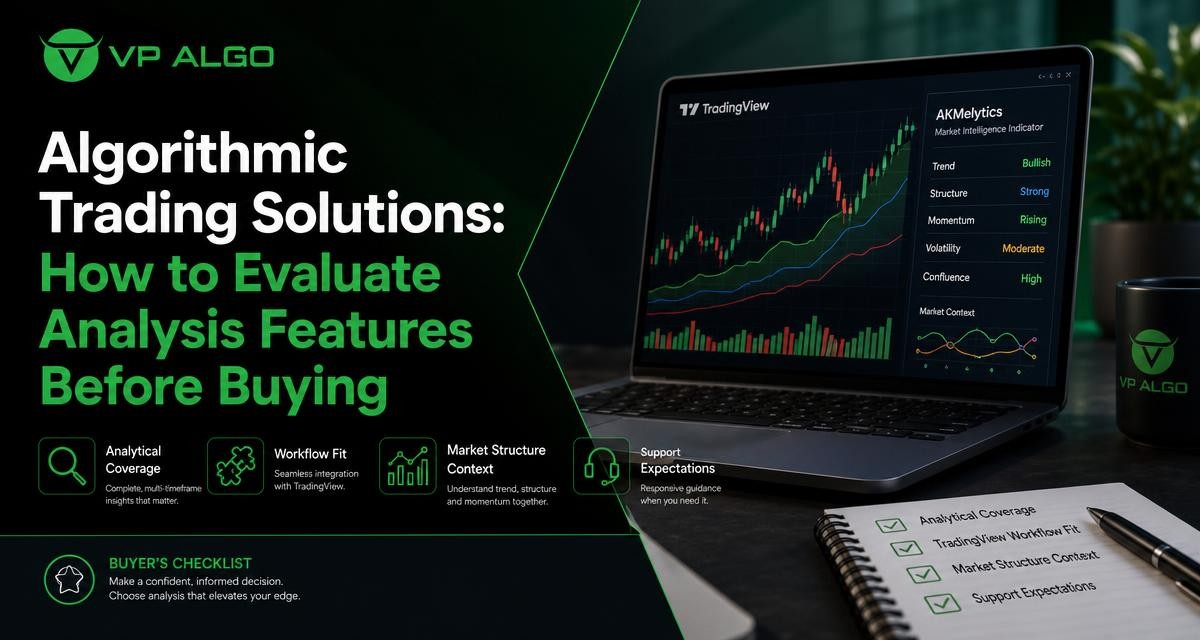
Choosing between algorithmic trading solutions requires more than looking at a chart screenshot or a list of technical terms. A useful tool should fit your TradingView workflow, present analysis you can understand, and provide enough context to support a consistent decision-making process. Before buying, assess its analytical coverage, market-structure features, multi-timeframe workflow, access process and support expectations.
What should algorithmic trading solutions actually help you do?
Algorithmic trading solutions can refer to indicators, rule-based tools and other software designed to organize market information. They are not automatically trading bots, brokers or financial advisers. In the context of TradingView, an algorithmic tool may display calculated conditions, trend information, momentum signals or market-structure events directly on a chart.
The practical value depends on how the tool helps you interpret a market. A crowded chart with many isolated signals may create more confusion than clarity. A better starting point is to identify the questions you want the tool to support:
- What is the broader trend on the timeframe being analyzed?
- Is momentum supporting or weakening that trend?
- Has the market formed a meaningful structural change?
- Is there evidence of institutional activity or smart money conditions in the tool’s analysis?
- Can the information be reviewed across more than one timeframe?
- Can you use the output as part of your own documented trading plan?
These questions keep the buying decision focused on analysis rather than on promises of outcomes. No indicator can remove market uncertainty or guarantee profitable trades, so the goal should be clearer market evaluation, not certainty.
Start with analytical coverage, not the sales label
Words such as “intelligence,” “algorithmic,” and “smart money” can describe a product’s positioning, but they do not tell you enough about how it works in practice. Ask what categories of information the indicator covers and whether those categories match your process.
| Analysis area | Questions for evaluation | Why it matters |
|---|---|---|
| Trend | Does the tool help you assess direction and changing trend conditions? | Trend context can help prevent isolated signals from being viewed without the broader market picture. |
| Momentum | Does it show momentum information, and can you understand what a signal represents? | Momentum may add context when judging whether movement is strengthening or losing force. |
| Market structure | Does the tool identify or organize structural developments on the chart? | Structure can provide a framework for considering breaks, shifts and potential changes in market behavior. |
| Institutional activity | Does it include a clearly explained approach to institutional flow or activity? | This may help users study where larger market participation could be relevant, without treating the output as certainty. |
| Smart money concepts | Are smart money conditions presented in a way that fits your existing analysis? | Clear presentation is more useful than a label that cannot be connected to a repeatable process. |
| Multi-timeframe assessment | Can you compare broader and more immediate conditions? | Different timeframes can provide context for whether a short-term setup agrees with the wider trend. |
The key is not to collect every possible feature. Instead, look for coverage that reduces gaps in your analysis. For example, a trader who already has a preferred momentum tool may place more value on market structure or multi-timeframe trend assessment. Another trader may need a more organized view of momentum and trend before studying smart money concepts.
Evaluate how the tool fits your TradingView workflow
A TradingView indicator is most useful when it fits the way you already review charts. Consider how you open charts, mark levels, compare timeframes and record decisions. If a tool requires you to change your entire process, determine whether the change improves clarity or simply adds complexity.
Check chart readability
Chart presentation matters because analysis is performed under time and attention constraints. Review whether labels, lines and signals can be interpreted without covering important price action. You should also ask whether the visual output helps you distinguish trend information from momentum, structure or other conditions.
Do not judge a tool only by the number of items displayed. More markers do not necessarily mean better analysis. A useful display should make it easier to identify the information relevant to your plan, while leaving room for your own price and risk review.
Consider your timeframe routine
Many traders use a broader timeframe to understand context and a lower timeframe to study possible entries. If multi-timeframe trend assessment is part of your preferred process, check whether the solution supports that type of review in a way you can follow consistently.
Before buying, write down a simple routine. For example, you might review the broader trend first, then assess momentum, inspect market structure and only afterward examine a potential setup. The exact routine is personal, but writing it down helps you determine whether a product will be used or ignored after purchase.
Separate analysis from execution
An indicator on TradingView may help you interpret chart conditions, but that does not mean it is a broker, an automated execution system or a guaranteed signal service. Confirm what the product is designed to provide. If your objective is chart-based analysis, assess the indicator on that basis rather than assuming it includes automated order placement or a trading bot.
Look closely at market-structure context
Market structure is often more useful when considered as context rather than as a stand-alone buy or sell instruction. A structural event may look different depending on the timeframe, recent volatility and surrounding price action. Ask how the tool presents structure and whether you can explain the information in your own words.
A good evaluation process includes questions such as:
- Does the tool help distinguish a possible continuation from a possible change in direction?
- Can you see the relevant structure without relying on a single isolated label?
- Does the display encourage you to review nearby price action and important levels?
- Can the information be combined with your own rules for risk and trade selection?
- Is the terminology explained clearly enough for a beginner to learn from it?
These questions are especially relevant when comparing a market structure indicator with a general collection of trading algorithms. A tool can be technically sophisticated but still be a poor fit if its output does not match the way you define structure.
Understand momentum and trend signals in context
Trend analysis and momentum evaluation answer related but different questions. Trend analysis concerns directional conditions over a chosen period, while momentum evaluation considers the strength or persistence of movement. A solution that includes both may give you more context, but only if the distinction between them is clear.
When reviewing an indicator, identify what each visual element is intended to communicate. Ask whether a momentum signal confirms the trend, warns of weakening movement or marks a different condition entirely. Avoid treating every signal as an instruction. Instead, consider whether it helps you apply a pre-existing trading strategy with greater consistency.
This is also a useful point at which to test your understanding. If you cannot describe what a signal means, when it may be less reliable or how it interacts with market structure, you may need product documentation or support before relying on it as part of your analysis.
Assess smart money and institutional-flow features carefully
Smart money concepts and institutional-flow language can attract attention, but these features should be evaluated with the same care as any other analytical category. Ask how the information is defined, how it appears on the chart and how it fits alongside trend, momentum and structure.
Do not assume that a reference to institutional activity proves what a particular market participant will do next. A chart-based indicator can organize an interpretation of market conditions, but it cannot provide certainty about future price movement. Use these features as part of a broader review that includes your own rules, risk considerations and independent judgment.
For beginners, clarity is particularly important. A smart money indicator should not require you to memorize a long list of labels without understanding their purpose. Experienced traders may instead focus on whether the tool adds useful context without duplicating information already present in their charts.
Review support, activation and access before purchase
Technical fit is only part of the buying decision. An indicator may be well suited to your analysis but still create friction if the access or installation process is unclear. Before purchasing, find out how access is provided, what information the seller needs from you and where to ask for help if the indicator does not appear as expected.
For the VP ALGO TRADING indicator offering, customers are instructed to provide their TradingView ID by email after purchase for product access. The company states that support is available for installation, activation or usage assistance. These details are worth confirming as part of your purchasing checklist, particularly if you are new to adding indicators on TradingView.
Questions to ask about support
- How is access activated after payment?
- Do you need to provide a TradingView ID or other account information?
- Where should installation or activation questions be sent?
- Is there documentation explaining the indicator’s terminology and features?
- Can you request help if the chart display does not match the product instructions?
- Are trial or access details clearly explained before you commit?
VP ALGO TRADING also offers a request-based seven-day free trial for its indicator and Telegram channel, according to the supplied company information. Because eligibility and other terms can change, review the current conditions directly with the company before relying on the trial as part of your decision.
Use a structured buying checklist
Comparing algorithmic trading solutions is easier when every candidate is reviewed against the same criteria. The following checklist can help you avoid choosing based on a single screenshot, a long feature list or an assumption about results.
- Define your objective. Decide whether you need trend analysis, momentum context, market structure, smart money analysis, multi-timeframe review or a combination.
- List your current tools. Identify what your existing chart already provides so you can look for useful coverage rather than unnecessary duplication.
- Review the terminology. Make sure you can understand the purpose of each major signal or visual element.
- Test workflow fit. Consider how the tool will fit into your chart review, journaling and decision-making routine.
- Check the boundaries. Confirm whether the product is an indicator for analysis or whether it includes other functions. Do not assume automated execution or personalized advice.
- Confirm access requirements. Review activation instructions, TradingView requirements and the appropriate support channel.
- Evaluate the trial or demonstration carefully. Use any available access period to judge clarity and usability, not to expect guaranteed performance.
- Keep risk decisions separate. An indicator can support analysis, but position sizing, risk limits and trade selection remain your responsibility.
How VP ALGO TRADING fits this evaluation process
VP ALGO TRADING develops and sells indicators and algorithmic trading tools for TradingView. Its identified Delphi Intelligence Smart Money Indicator includes features related to trend analysis, momentum signals, market structure, institutional flow monitoring, multi-timeframe trend assessment and smart money analysis. These categories align with the main areas a buyer should review when comparing chart-based algorithmic trading solutions.
The relevant question is whether those features fit your own method. A beginner may value a structured way to study several market conditions in one TradingView workflow. A more experienced trader may want to determine whether the indicator adds useful context to an established process. In both cases, review the tool as an aid to market evaluation rather than as a promise of a particular trading outcome.
Before buying the AKMelytics – Market Intelligence Indicator, clarify the current product instructions, access process and support route. Then use the checklist above to decide whether its coverage and presentation match the way you analyze charts.
Final considerations before buying
The best algorithmic trading solutions are not necessarily the ones with the most features. They are the ones that present relevant information clearly, fit the trader’s workflow and can be used consistently without encouraging unrealistic expectations.
Focus your review on analytical coverage, TradingView compatibility, market-structure context, signal interpretation and practical support. If a product helps you organize trend, momentum, structure and smart money conditions while leaving room for your own judgment and risk controls, it may deserve closer consideration. Treat the purchase as a decision about analytical support—not a guarantee of trading success.
Frequently asked questions
What are algorithmic trading solutions?
Algorithmic trading solutions are software tools that use programmed calculations or rules to organize and present market information. They may include TradingView indicators, but they are not automatically trading bots or automated execution systems.
What should I compare when choosing a TradingView indicator?
Compare its analytical coverage, chart readability, timeframe support, terminology, workflow fit, access process and support options. Also confirm what the product does not provide so you do not make assumptions about execution or advice.
Why does market structure matter when evaluating an indicator?
Market structure provides context for considering directional changes and continuation conditions. It should be reviewed alongside price action, trend and momentum rather than treated as a guaranteed instruction.
Are smart money indicators a guarantee of profitable trades?
No. Smart money features can organize certain market interpretations, but they cannot guarantee future price movement, profits or the elimination of losses. They should be used as part of an independent trading and risk process.
Can beginners use algorithmic trading tools?
Beginners can use them as educational and analytical aids, provided they understand the terminology and do not treat signals as financial advice. Starting with a simple, documented chart-review routine can make the tool easier to evaluate.
How does VP ALGO TRADING provide access to its indicator?
According to the supplied company information, customers provide their TradingView ID by email after purchase for product access. Support is available for installation, activation or usage assistance, and current instructions should be confirmed before purchase.
Should I use an indicator as my complete trading strategy?
An indicator is better treated as one part of a broader process. Define your own analysis rules, risk limits and trade-selection criteria, and use the tool to add context rather than to replace independent judgment.


Recent Comments