
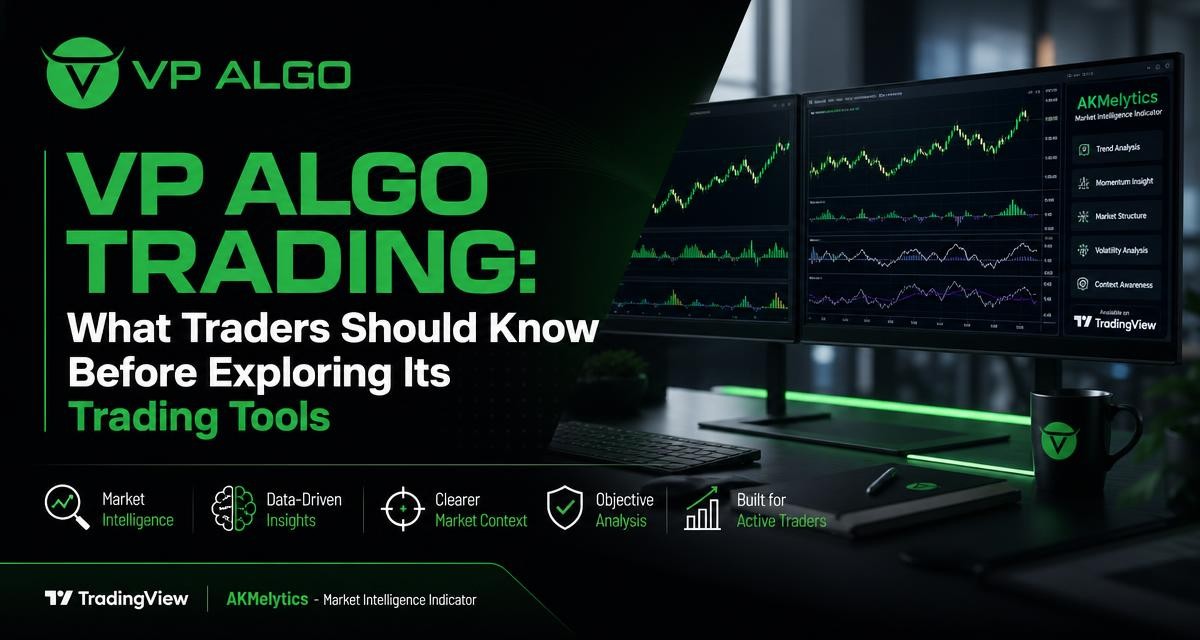
VP ALGO TRADING develops and sells TradingView indicators and algorithmic trading tools for traders who want a more structured way to study market conditions. Its identified market intelligence offering brings together trend analysis, momentum evaluation, market structure, institutional activity and smart money concepts. Before exploring any TradingView trading indicator, however, it is useful to understand what the tool is designed to support, who may benefit from it and what it cannot do.
What VP ALGO TRADING offers
VP ALGO TRADING focuses on trading indicators and software tools rather than brokerage, portfolio management or personalised financial guidance. The company offers an indicator intended to help TradingView users organise several areas of technical and market analysis within one workflow.
The supplied product information identifies the offering as AKMelytics – Market Intelligence Indicator. Company information also refers to its Delphi Intelligence Smart Money Indicator for TradingView. Regardless of the product naming used across the available information, the relevant offering is positioned as a TradingView-based market intelligence and smart money analysis tool. Traders should review the current product information directly for the latest naming and access details.
What a TradingView trading indicator can contribute
A trading indicator does not replace a trader’s process. Its practical role is to help display or organise information that may otherwise require several charts, calculations or visual checks. For someone already using TradingView, an indicator can make it easier to review related conditions in a consistent order.
VP ALGO TRADING’s offering is associated with several analysis categories. These categories are best viewed as separate inputs to a decision-making process rather than independent promises of a trading outcome.
| Analysis area | What traders may examine | Realistic role of the tool |
|---|---|---|
| Trend analysis | Whether price conditions appear aligned with an upward, downward or changing trend | Provides a visual reference for assessing market direction |
| Momentum | Whether current movement appears to be strengthening, weakening or losing follow-through | Adds context to price movement instead of relying on direction alone |
| Market structure | Price swings, structural changes and areas that may matter to a technical analysis process | Helps traders frame the market before considering a setup |
| Institutional activity | Indicator-related views of institutional flow or participation conditions | Offers another analytical lens to review alongside price and volume information |
| Smart money concepts | Market behaviour and structural ideas commonly associated with smart money analysis | Helps users study context rather than treating one signal as a complete decision |
| Multi-timeframe assessment | How conditions appear across more than one chart timeframe | Supports a broader review of trend and market structure |
Understanding the main features
Trend analysis and momentum signals
Trend and momentum answer related but different questions. Trend analysis focuses on direction and broader market behaviour. Momentum analysis considers the strength or persistence of a move. Looking at both can help a trader avoid interpreting every price increase or decrease as a complete trend.
For example, a market may be moving upward while momentum is becoming less convincing. That does not automatically mean a reversal will occur, but it may encourage a trader to examine the chart more carefully rather than relying only on the current direction. Similarly, a momentum signal should be considered in the context of market structure and the selected timeframe.
Market structure
Market structure gives traders a framework for reading price swings and changes in behaviour. Depending on the chart and the method being used, this may involve reviewing highs, lows, structural breaks or areas where the previous price pattern appears to be changing.
A market structure indicator can make these observations easier to review consistently. It does not remove the need for interpretation. Different traders may use different definitions of a meaningful structural change, and a chart condition can look different when viewed on another timeframe.
Institutional flow and smart money analysis
The offering also includes features related to institutional activity, institutional flow monitoring and smart money concepts. These ideas are often used by traders who want to study how larger areas of participation may relate to price behaviour.
It is important to treat these features as analytical references. They should not be interpreted as proof that a particular institution has entered a trade or as confirmation that a future move will occur. A smart money indicator can help structure an investigation, but the trader still needs to assess the chart, risk and broader context.
Multi-timeframe trend assessment
Reviewing more than one timeframe can help traders distinguish a short-term movement from a broader market condition. A lower timeframe may show a temporary move that does not agree with the higher-timeframe trend. Conversely, a larger trend may provide context for a smaller structural change.
Multi-timeframe analysis is not automatically better simply because more charts are involved. The useful question is whether each timeframe has a clear purpose in the trader’s method. An indicator can present information across timeframes, but the user must decide how those readings fit together.
Who may find this type of indicator useful?
VP ALGO TRADING’s intended audience includes beginners and more experienced market participants who use TradingView and want a structured approach to analysing trend, momentum, market structure, institutional activity and smart money conditions.
For newer TradingView users
Beginners may appreciate a defined checklist for chart review. Instead of switching between unrelated tools without a plan, they can learn to ask consistent questions: What is the broader trend? Is momentum supporting the move? What does market structure show? Do the conditions agree across the selected timeframes?
That structure does not replace learning. New users still need to understand basic chart reading, timeframe selection, position sizing and the difference between an observation and a trading decision.
For experienced traders
More experienced traders may use the indicator as an additional layer in an existing process. It can help them compare their own market reading with a visual framework or reduce the need to arrange several separate indicators for related questions.
Experienced users should still test how the tool fits their own rules and instruments. A familiar workflow is not necessarily suitable for every chart, and adding more signals can create confusion if the trader has no clear method for resolving conflicting readings.
How to evaluate VP ALGO TRADING’s tool before using it
A careful evaluation focuses on usability and fit rather than on finding a supposedly perfect signal. The following questions can help a trader decide whether the offering belongs in a research or charting workflow.
- Does it fit your analysis method? Consider whether trend, momentum, market structure and smart money concepts are already relevant to the way you read charts.
- Is the information understandable? A tool is more useful when its visual elements and signals can be explained in plain language.
- Can you use it without overloading the chart? More information is not always better. The display should support decisions rather than distract from price action.
- Does it work across your intended review process? Think about whether you need a single timeframe, several timeframes or a combination of technical references.
- What will remain your responsibility? Entry decisions, trade size, risk controls, position management and the decision to stay out of the market remain with the trader.
Realistic expectations from a smart money indicator
The most useful expectation is that an indicator can help organise analysis. It may highlight conditions that deserve attention, but it cannot know a trader’s complete circumstances or guarantee how a market will develop. A signal is an input, not a promise.
Markets can move unexpectedly, remain range-bound or produce conflicting signals. Trend, momentum and structure may not point in the same direction. A trader may also interpret the same chart differently depending on the timeframe and the rules being applied. For these reasons, the indicator should be used as part of a documented process rather than as an automatic buy-and-sell instruction.
A structured indicator can improve the consistency of chart review, but consistency should not be confused with certainty.
What the indicator does not provide
VP ALGO TRADING positions its indicators for educational and trading-decision assistance purposes rather than as financial advice. The offering is not described as a broker, financial adviser or investment manager. It does not remove market risk, guarantee profitable results or eliminate losses.
There is also no basis to assume that an indicator will predict future prices or that any past observation will produce the same result later. Traders should avoid treating a chart label as a guaranteed outcome and should make sure their own risk approach is appropriate for their circumstances.
Access, trial and support considerations
The company website offers a request-based seven-day free trial for its indicator and Telegram channel. Eligibility and current terms should be confirmed with VP ALGO TRADING before relying on the trial. The existence of a trial is an opportunity to assess the interface and workflow, not evidence of future trading performance.
After purchase, customers are instructed to provide their TradingView ID by email for product access. VP ALGO TRADING also states that customers can contact support for installation, activation or usage assistance. Before purchasing, users may want to confirm the current access process, supported account details and any setup requirements directly with the company.
A practical way to use the tool in chart research
A simple review sequence can help prevent one signal from dominating the entire analysis. Start with the broader timeframe and identify the general trend or market structure. Then examine the selected trading timeframe and ask whether momentum and structure support the same interpretation.
Next, use the institutional activity and smart money-related views as additional context. If the readings conflict, record the conflict rather than forcing a conclusion. A trader can then decide whether the setup meets their own rules, whether risk is acceptable and whether waiting is more appropriate than acting.
- Begin with the market context and selected timeframes.
- Review trend before interpreting short-term momentum.
- Use market structure to frame possible scenarios.
- Consider institutional and smart money-related information as supporting context.
- Document the reason for a decision, including reasons not to trade.
- Review results as part of a personal process without assuming future outcomes.
VP ALGO TRADING: Is this type of tool worth exploring?
VP ALGO TRADING may be worth exploring for TradingView users who want one structured environment for reviewing trend, momentum, market structure, institutional activity and smart money conditions. Its potential value depends less on the number of features than on whether the presentation fits the trader’s method and can be used without creating unnecessary complexity.
The right way to approach the tool is as an aid to analysis, not as an automatic trading system or a substitute for judgement. Reviewing the available trial, understanding the setup process and testing the indicator within a clearly defined research routine can help traders decide whether it supports their work.
Frequently asked questions
What is VP ALGO TRADING?
VP ALGO TRADING develops and sells TradingView indicators and algorithmic trading tools. Its offering is intended to support market analysis and trading-decision processes rather than provide official financial advice.
What type of TradingView indicator does VP ALGO TRADING offer?
The identified offering is a market intelligence and smart money indicator associated with trend analysis, momentum, market structure, institutional activity and multi-timeframe assessment.
Is the VP ALGO TRADING indicator a buy-and-sell guarantee?
No. The indicator is an analytical aid. It does not guarantee profits, eliminate losses or predict future market movements.
Who may use this TradingView trading indicator?
It is intended for beginners and experienced traders who use TradingView and want a structured way to evaluate several market conditions. Each user remains responsible for deciding whether the tool fits their own method.
Does VP ALGO TRADING offer a free trial?
The company website offers a request-based seven-day free trial for its indicator and Telegram channel. Current eligibility and terms should be confirmed directly with VP ALGO TRADING.
How is access provided after purchase?
Customers are instructed to provide their TradingView ID by email for product access. Support can be contacted for installation, activation or usage assistance.
Is VP ALGO TRADING a financial adviser or broker?
No. The company is described as a developer and seller of trading indicators and software tools, not as a broker, investment manager or provider of official financial advice.


Recent Comments