
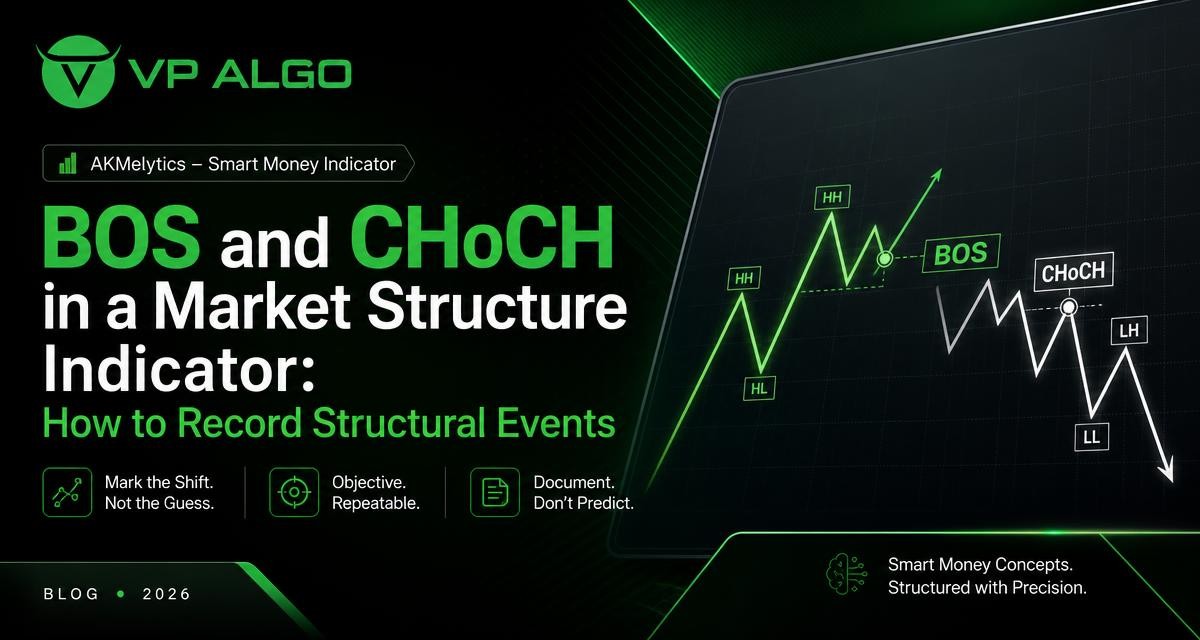
A market structure indicator can help traders record important changes in price action, including Break of Structure (BOS) and Change of Character (CHoCH). These events are useful observations, but they are not standalone predictions. Their value depends on how clearly they are defined, where they appear in the broader trend, and what other market information supports or challenges the interpretation.
What BOS and CHoCH describe
BOS and CHoCH are terms commonly used in market structure analysis and smart money concepts. Both refer to price moving through a previously identified swing level, but they usually answer different questions. BOS generally describes continuation: price breaks a relevant high in an upward structure or a relevant low in a downward structure. CHoCH generally describes a possible change in behaviour: price breaks a structural level against the direction that had been dominant.
The terminology is not applied identically by every trader or indicator. A useful recording process therefore begins with a consistent definition. Before reviewing a chart, decide which swing points count as structural, whether a candle must close beyond a level, and how much significance to assign to minor internal movements compared with larger swing points.
| Event | Typical structural meaning | Question to record |
|---|---|---|
| BOS | Continuation or confirmation of an existing directional structure | Which prior swing was broken, and did the break support the current trend? |
| CHoCH | Possible early change in directional behaviour | Was the level broken against the prior structure, and is there confirmation afterward? |
| Unconfirmed movement | A temporary breach, wick or ambiguous price move | Did price actually establish acceptance beyond the level, or only test it? |
Why recording matters more than simply spotting a label
A chart label can make a structural event easy to notice, but it does not preserve the reasoning behind that label. Without notes, a trader may later remember only that a BOS or CHoCH appeared and overlook the timeframe, market phase, nearby liquidity, volatility, or the fact that the event occurred inside a larger opposing trend.
Recording creates a repeatable review process. Instead of asking whether a label was “right,” the trader can ask whether the event was defined consistently, whether the surrounding conditions were documented, and how price behaved afterward. This turns BOS and CHoCH into reviewable observations rather than isolated signals.
The minimum event record
Each entry should identify the chart context and the structural level involved. A short record is usually more useful than a long narrative that mixes observation with hindsight. The following fields provide a practical starting point:
- Date and time: Record when the event became visible according to the chosen rule.
- Instrument and timeframe: Note the chart used, because the same price movement may represent a structural event on one timeframe and ordinary noise on another.
- Event type: Mark BOS, CHoCH, or unconfirmed breach.
- Broken swing: Identify the prior high or low that price tested or crossed.
- Break condition: State whether the event required a candle close, a wick, or another predefined condition.
- Directional context: Describe the current sequence of higher highs and higher lows, or lower highs and lower lows.
- Supporting and conflicting information: Note momentum, trend context, market flow or other observations available in the analysis.
- Follow-up: Record whether price continued, retraced, invalidated the event, or remained unclear.
How to define the structural level before recording an event
The quality of a BOS or CHoCH record depends heavily on the level selected. A recent minor high may be important for short-term structure but irrelevant to a broader swing analysis. Conversely, a major swing level may be too distant to describe the immediate behaviour of price. The record should therefore state whether the event concerns internal structure, swing structure, or a higher-timeframe reference.
Separate internal and swing structure
Internal structure consists of shorter movements inside a larger price leg. It can change frequently and may help describe local momentum. Swing structure refers to more prominent turning points that define a broader sequence. A CHoCH in internal structure does not automatically mean that the higher-timeframe trend has changed. Recording the structural scale prevents a small event from being presented as a major reversal.
One practical approach is to maintain separate notes for the higher timeframe and the execution or observation timeframe. For example, a higher-timeframe record might describe the broader sequence of swings, while a lower-timeframe record tracks the local BOS or CHoCH that develops within it. The purpose is not to force agreement between timeframes, but to make the relationship visible.
Use a clear break rule
Traders should decide in advance what qualifies as a break. Some methods focus on a candle close beyond the swing level; others pay attention to wicks or intrabar movement. Neither description should be silently changed after the event. If the rule is unclear, the record should say so and classify the movement as ambiguous rather than giving it greater certainty than the chart supports.
A step-by-step BOS and CHoCH recording process
1. Describe the existing structure first
Before marking the event, write a short description of the preceding price sequence. In an upward structure, this might include a series of higher highs and higher lows. In a downward structure, it might include lower highs and lower lows. If the chart is ranging or mixed, say that directly. A neutral description is preferable to forcing a bullish or bearish classification.
2. Mark the relevant swing and the direction of the break
Identify the level that price crossed and state whether the break occurred in the direction of the existing structure or against it. A break above a relevant high during an established upward sequence may be recorded as BOS. A break below a relevant low during that same sequence may be recorded as a potential CHoCH, provided the level and break rule meet the chosen criteria.
3. Record confirmation separately from detection
The moment an event is detected and the later evidence that supports or weakens it should not be merged. Use separate fields such as “initial observation” and “follow-up.” This avoids rewriting the original record with information that was unavailable at the time.
Follow-up evidence may include a continuation beyond the broken level, a retest, a move back inside the prior range, or another structural break. These observations do not guarantee a particular outcome. They simply show how the market behaved after the initial event.
4. Add broader context
A structural break should be viewed alongside other available information. This may include trend analysis, momentum evaluation, relative strength, market flow, volatility or a higher-timeframe trend assessment. The purpose is to build context, not to collect as many labels as possible.
For instance, a CHoCH that appears against a strong higher-timeframe movement may be a local change rather than a complete reversal. A BOS that occurs inside a narrow, unsettled range may also deserve a different note from a break that follows a clear directional sequence. The record should explain the setting without claiming certainty.
5. Review the event using a fixed horizon
Choose a review rule before studying results. You might examine the next defined number of candles, the next structural test, or the next meaningful swing. The exact horizon will depend on the trader’s method, but it should be applied consistently. Otherwise, records may selectively emphasise events that developed favourably and ignore those that remained unresolved.

Using a market structure indicator without outsourcing judgment
An indicator can make structural events easier to display and organise. The AKMelytics – Smart Money Indicator is described as a TradingView technical analysis tool that includes market structure features such as BOS and CHoCH events, together with trend, momentum, market flow, relative strength, smart money concepts and multi-timeframe analysis. These features can support a more structured chart review.
However, an indicator label still needs interpretation. A trader should understand the settings and the conditions under which the event is displayed, then record the relevant context rather than treating the label as an instruction. Configurable alerts can help bring attention to an event, but an alert does not establish that a trade is appropriate or that a trend will continue.
A practical indicator review checklist
- What timeframe generated the event?
- Which high or low did the indicator identify as structural?
- Does the chart show a continuation event or a possible change in behaviour?
- Was the level crossed by a wick, a close, or another rule?
- Does the higher-timeframe structure agree, conflict or remain neutral?
- Are momentum, trend and market-flow observations aligned or mixed?
- What would invalidate the original interpretation?
Common recording mistakes
Calling every break a CHoCH
A small movement against the recent direction is not automatically a meaningful change of character. If the broken level is only an internal fluctuation, describe it at that scale. A stronger record distinguishes between a local structural change and a broader reversal hypothesis.
Treating BOS as proof of continuation
BOS is a description of a break in the direction of an identified structure. It is not proof that price must continue. Price can retrace, consolidate or produce another structural event afterward. Recording the event as evidence of current behaviour is more precise than recording it as a guaranteed future outcome.
Ignoring failed breaks
Failed breaks are valuable for review. If price crosses a level and then returns inside the prior structure, record that sequence rather than deleting or relabelling the original observation. It can reveal whether the definition was too sensitive, whether the level was poorly selected, or whether the market was unsettled at the time.
Mixing timeframes without saying so
A lower-timeframe CHoCH and a higher-timeframe BOS can occur at the same time without being contradictory. They may describe different layers of structure. Every entry should identify its timeframe and, where relevant, the higher-timeframe condition that surrounds it.
Example of a concise event log
The following format can be adapted to a spreadsheet or chart journal. It is designed to separate observation from interpretation:
| Field | Example entry format |
|---|---|
| Context | Higher-timeframe direction, range or mixed structure |
| Event | BOS, CHoCH or unconfirmed breach |
| Level | Prior swing high or swing low |
| Break rule | Candle close, wick or selected indicator condition |
| Confluence | Trend, momentum, relative strength, flow or multi-timeframe observations |
| Conflict | Information that does not support the initial interpretation |
| Follow-up | Continuation, retest, return inside range or unresolved |
Keeping the language factual improves later analysis. “Price closed beyond the prior swing high” is an observation. “The market will rise from here” is a prediction. A good journal can contain a separate hypothesis, but it should clearly distinguish that hypothesis from what the chart has already shown.
How this fits into a broader smart money concepts workflow
Smart money concepts are often used as a framework for discussing liquidity, structure and institutional-style market behaviour. BOS and CHoCH are only part of that framework. They can be combined with observations about trend, momentum, market flow and higher-timeframe context, but no individual event should be treated as a complete market explanation.
A disciplined workflow might begin by describing the higher-timeframe environment, then identifying the relevant swing points, recording the structural event, and finally reviewing what happened afterward. This sequence keeps the focus on evidence and reduces the temptation to search for a label that confirms an existing view.
Final principles for better structural records
- Define BOS, CHoCH and break conditions before reviewing the chart.
- Record the timeframe and structural scale for every event.
- Separate the initial detection from later confirmation or invalidation.
- Use broader trend and momentum context without treating confluence as certainty.
- Keep failed breaks and ambiguous events in the journal.
- Review a consistent set of events instead of relying on memorable examples.
- Use a market structure indicator as an analytical aid, not as a substitute for judgment and risk awareness.
When documented this way, BOS and CHoCH become useful building blocks for market structure analysis. They help traders describe how price is behaving while leaving room for uncertainty, conflicting evidence and changing conditions. That is a more reliable use of structural events than treating every indicator label as a standalone forecast.
Frequently asked questions
What does BOS mean in market structure?
BOS means Break of Structure. It usually describes price breaking a relevant swing high or low in the direction of an existing structural sequence, often as a continuation observation.
What does CHoCH mean?
CHoCH means Change of Character. It usually refers to a break against the prior directional structure and may indicate a possible change in behaviour. It is not proof of a complete reversal.
Is every price break a BOS or CHoCH?
No. The significance of a break depends on the swing level, timeframe, break rule and surrounding structure. Minor fluctuations, wicks or ambiguous moves may be better recorded as unconfirmed events.
Should a BOS or CHoCH be treated as a trading signal?
It is better treated as a structural observation that requires context. Trend, momentum, timeframe relationships and other analysis may support or challenge the interpretation, but no label guarantees a future result.
How can a market structure indicator help with BOS and CHoCH?
It can display structural events consistently and help organise chart review. The trader should still understand the indicator’s conditions, verify the relevant level and record the broader context.
Why should traders record failed breaks?
Failed breaks show how price behaved after an apparent structural event. Including them in a journal helps reveal inconsistent definitions, sensitive settings and market conditions in which a label may be less informative.


Recent Comments