
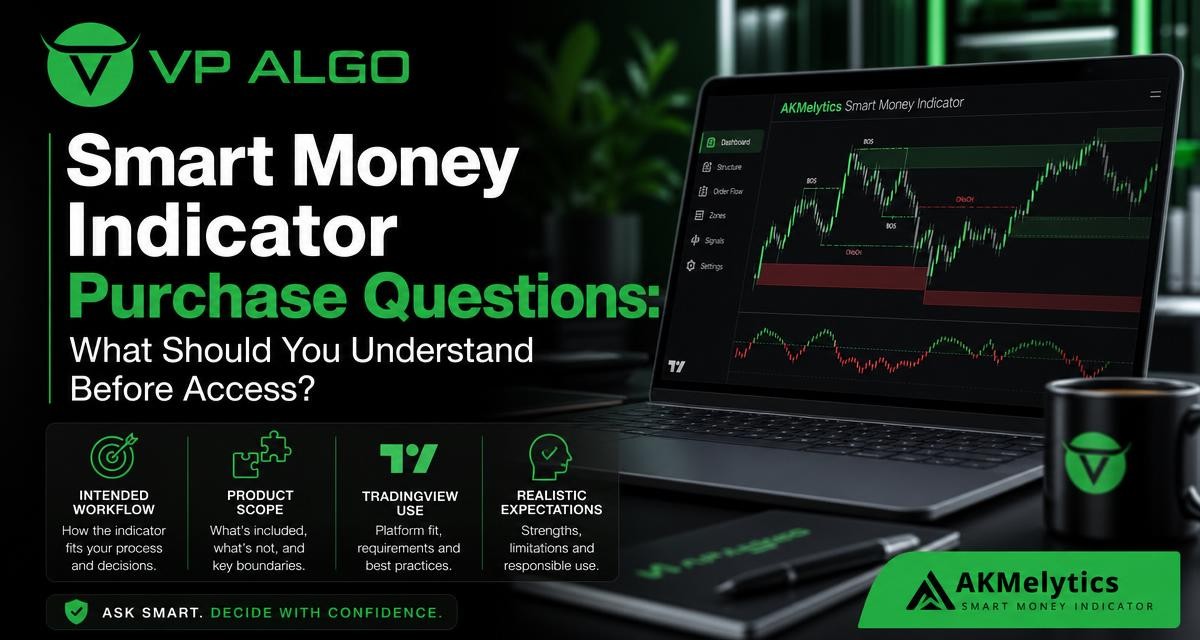
Buying a smart money indicator is not only a question of whether a chart looks more detailed after access. The more useful questions concern how the tool fits into your existing TradingView workflow, what its signals and analytical features are intended to show, and what it cannot decide for you. The AKMelytics Smart Money Indicator from VP ALGO TRADING is designed to bring several areas of technical analysis into one TradingView tool, including trend, momentum, market structure, market flow and smart money concepts. Understanding that scope before purchase can help you approach the indicator with clearer expectations.
What is a smart money indicator intended to do?
A smart money indicator is generally used to help traders study market behaviour associated with structure, momentum, trend and possible institutional activity. Rather than looking at a chart through only one measurement, a tool in this category may combine several forms of analysis to provide context around a potential setup. That context can help a trader ask better questions about direction, strength, structure and confirmation.
The AKMelytics Smart Money Indicator is described as a TradingView technical analysis tool that combines trading algorithms for momentum, trend analysis, market structure, market flow, relative strength and smart money concepts. Its purpose is to support the evaluation of potential trading setups and decision-making. It is not presented as financial advice, a guarantee of results or a replacement for a trader’s own analysis.
What does “smart money” mean in this context?
In trading discussions, “smart money” commonly refers to the study of market behaviour that may provide clues about larger or more informed participants. This can involve observing structure changes, directional pressure, flow and reactions around important chart areas. An indicator can organise these observations, but it cannot reveal every participant’s intentions or prove that a particular market move must occur.
That distinction matters before purchase. A smart money trading indicator should be treated as an analytical aid. It can help make a chart easier to review, but the information still requires interpretation alongside the broader market context and the trader’s own rules.
Which questions should you ask before buying?
Before requesting or purchasing access, clarify the practical scope of the product rather than focusing only on screenshots or individual signal labels. A useful pre-purchase review should cover five areas: what the indicator analyses, how it is used, what access involves, how it fits your process and which expectations are realistic.
| Question area | What to clarify | Why it matters |
|---|---|---|
| Analytical scope | Which trend, momentum, structure, flow and smart money features are included? | It helps you judge whether the tool supports the type of chart review you already perform. |
| TradingView workflow | How will the indicator fit into your charts, timeframes and alert routine? | A useful tool should be understandable within your normal analysis process. |
| Access | What TradingView account information is needed after purchase? | The correct account identification is relevant to product access. |
| Support | Where can you ask for activation, installation or usage assistance? | Knowing the available support route reduces avoidable access confusion. |
| Expectations | Is the indicator an analysis aid rather than a promise of profitable outcomes? | Clear expectations help prevent overreliance on automated-looking chart information. |
What features may be relevant to your workflow?
The AKMelytics Smart Money Indicator brings several analytical components together. The value of that combination depends on how you use the information. A trader who already reviews market structure, momentum and trend separately may appreciate a more centralised view. A newer trader may find the range of information useful as a framework for learning, provided each element is studied rather than treated as an automatic instruction.
Trend and momentum analysis
Trend analysis helps frame the broader direction being observed on a chart, while momentum analysis focuses on the strength or persistence of movement. Considering both can be more informative than asking only whether price is rising or falling. A directional move may be losing strength, or a developing move may not yet have enough momentum to support the trader’s interpretation.
The indicator includes trend analysis and momentum signals as part of its broader toolkit. These features can help you compare directional context with current movement. They do not, however, establish that a trade will succeed or identify a universally correct entry and exit.
Market structure, BOS and CHoCH
Market structure is concerned with how price develops successive highs, lows and directional changes. The indicator includes structure events such as break of structure, commonly abbreviated as BOS, and change of character, commonly abbreviated as CHoCH. These labels can give traders a consistent vocabulary for discussing possible continuation or change in market behaviour.
Structure events still need context. A break on one timeframe may look different when viewed against a higher-timeframe trend. A CHoCH label may signal a change worth investigating, not a compulsory trade. Reviewing the surrounding price action, momentum and broader conditions remains part of responsible analysis.
Institutional flow and smart money concepts
The indicator also includes features related to institutional flow monitoring and smart money concepts. These may help traders organise their observations of market flow and potential participation patterns. Such information is best used to develop a hypothesis about what the market may be doing, followed by confirmation through the trader’s chosen process.
It is important not to interpret an institutional flow feature as direct access to every large participant’s orders or intentions. The indicator provides analytical information on a chart. It does not guarantee that an apparent flow condition will continue or produce a particular result.
Relative strength, Fibonacci and reference levels
Relative strength can add another perspective when assessing how forcefully a market or movement is behaving. The indicator also includes Fibonacci projections and volatility-based target and risk reference levels. These features can help traders mark areas for further consideration and structure their review of a potential setup.
Reference levels are not the same as guaranteed targets, fixed outcomes or personalised risk advice. They should be assessed in relation to the chart, the timeframe and the trader’s own risk-management approach. A displayed level should support a decision process, not replace one.
How does the indicator fit into TradingView use?
AKMelytics is designed for TradingView, so the relevant question is not simply whether you use TradingView, but how you use it. Consider the charts you regularly review, the timeframes that matter to your process and whether you prefer a visual dashboard, chart events, alerts or a combination of these elements. The indicator includes multi-timeframe trend assessment, dashboard context and configurable TradingView alerts, which may be useful for traders who want several types of information available within their charting environment.
Multi-timeframe analysis can help separate broader context from more immediate movement. For example, a trader may review a higher timeframe for directional structure and a lower timeframe for a developing setup. The indicator can support that type of comparison, but the exact interpretation remains the trader’s responsibility. Different timeframes can produce different signals or structure readings, so they should not be treated as interchangeable.
What should you understand about alerts?
Configurable alerts can help you monitor chart conditions without watching a screen continuously. They may be useful when you want to be notified about selected events or conditions that deserve a closer review. An alert is a prompt to investigate, not an instruction to enter a position automatically.
Before relying on alerts, decide what event you want to monitor and what additional checks you will perform after receiving it. This prevents an alert from becoming an isolated buy or sell decision. It also keeps the tool aligned with your trading plan instead of allowing every notification to dictate your activity.
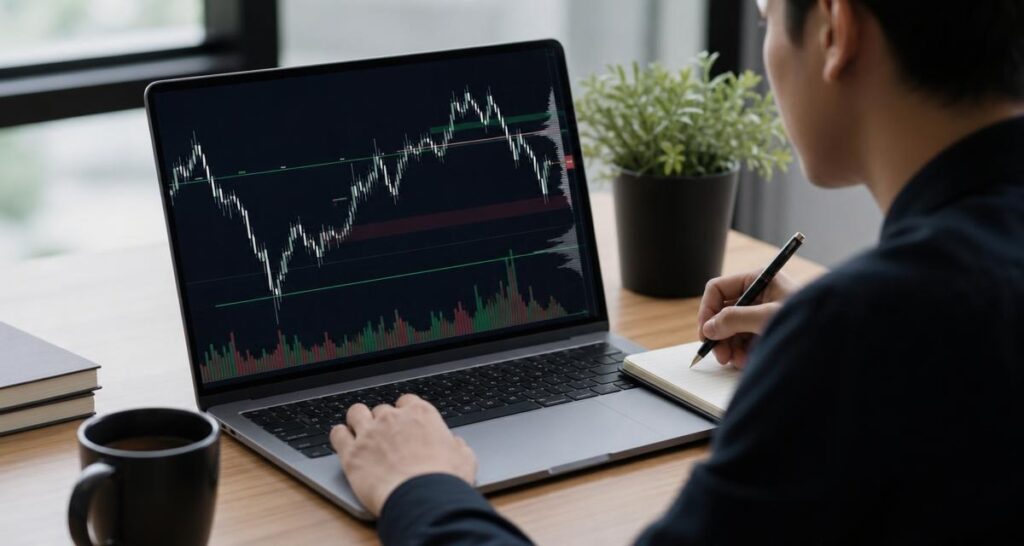
What does access involve after purchase?
VP ALGO TRADING states that, after purchase, customers are instructed to provide their TradingView ID by email for product access. This account detail is used to identify the TradingView account that should receive access to the indicator. If you are considering purchase, make sure you understand which TradingView ID is required and provide the correct information through the requested support channel.
The company also states that customers can contact support for installation, activation or usage assistance. This article focuses on pre-purchase questions rather than installation instructions, but it is still useful to know that access and usage questions can be raised with the company after purchase. Keep your account information accurate and retain relevant purchase or support communications in case you need to refer back to them.
Is the free trial worth asking about?
The website offers a request-based 7-day free trial for its indicator and Telegram channel. If you are interested in trying the product before committing, you can ask VP ALGO TRADING about current trial availability and the conditions that apply. The supplied information does not establish specific eligibility rules, pricing arrangements or subscription benefits, so those details should be confirmed directly rather than assumed.
A trial, where available, can be used to assess whether the indicator’s layout and analytical categories make sense for your workflow. It should not be treated as proof of future performance. A short period may help you understand usability and interpretation, but it cannot establish guaranteed trading results.
Who may find a smart money indicator useful?
The tool may be relevant to TradingView users who want a structured way to review trend, momentum, market structure, institutional activity and smart money conditions. It can also suit traders who prefer to compare several analytical perspectives rather than switching between unrelated tools. Beginners may use the categories as a learning framework, while more experienced participants may use them to organise an existing process.
Suitability depends on your preferred style and level of involvement. If you expect a tool to make all trading decisions, remove uncertainty or guarantee profitable results, this is not a realistic use case. If you are prepared to interpret chart information, test how it fits your method and retain responsibility for your decisions, the product may be more relevant to your needs.
Questions to ask yourself before access
- Do I already use TradingView as part of my chart analysis?
- Would trend, momentum and structure information help me organise my review?
- Am I comfortable interpreting BOS, CHoCH, flow and other analytical conditions?
- Do I have a process for checking an alert before taking action?
- Can I evaluate the tool without assuming that any signal guarantees an outcome?
- Do I understand that the indicator supports analysis rather than providing financial advice?
These questions are more useful than asking whether any indicator is simply “right” or “wrong.” A charting tool should be assessed by how clearly it supports your process, how well you understand its information and whether it encourages disciplined review.
What should realistic expectations look like?
A realistic expectation is that the indicator can help structure the way you inspect market conditions. It may place trend, momentum, structure, flow, relative strength, projections and reference levels into a more organised TradingView workflow. That organisation can make it easier to compare factors and identify areas that deserve further analysis.
An unrealistic expectation is that a smart money indicator will eliminate uncertainty, predict every market move or remove the possibility of loss. No supplied product information supports guaranteed profits, risk-free trading or a promise that losses will be eliminated. The indicator is intended for educational and trading-decision assistance purposes, not as official financial advice.
Use the indicator to improve the questions you ask about a chart, not to avoid asking questions altogether.
How can you evaluate the product responsibly?
Start by identifying the decisions you want the tool to support. You might want a clearer view of higher-timeframe trend, a way to study structure events, or a dashboard that brings several conditions together. Write down those needs before reviewing the indicator so that you judge it against your actual workflow rather than against general promotional expectations.
Next, observe how the information affects your analysis. Do the labels and dashboard context make your review clearer? Can you explain why a condition matters? Do alerts lead to a consistent checking process? If a feature creates confusion, seek usage assistance or spend more time learning its role before acting on it.
Finally, keep product information separate from financial decision-making. VP ALGO TRADING develops and sells TradingView indicators and algorithmic trading tools, but the existence of analytical features does not make the company a broker, investment manager or financial adviser. Your decisions should reflect your own research, risk tolerance and chosen trading process.
Frequently asked questions
What is the AKMelytics Smart Money Indicator?
It is a TradingView technical analysis tool from VP ALGO TRADING that combines trend analysis, momentum, market structure, market flow, relative strength and smart money concepts to support the review of potential trading setups.
Does the indicator provide financial advice?
No. The indicator is positioned as an educational and trading-decision assistance tool. It does not provide official financial advice, personalised investment management or guaranteed trade outcomes.
Can the indicator be used with multiple timeframes?
Yes. Its described features include multi-timeframe trend assessment. Different timeframes should still be interpreted together and checked against your own analysis rather than treated as automatic instructions.
Does it include TradingView alerts?
The indicator includes configurable TradingView alerts. An alert should be treated as a prompt for further review, not as a guaranteed buy or sell recommendation.
What TradingView information is needed for access?
After purchase, customers are instructed to provide their TradingView ID by email so the product can be linked to the correct account. Confirm the required details with VP ALGO TRADING if you are unsure which account identifier to provide.
Is a free trial available?
VP ALGO TRADING states that it offers a request-based 7-day free trial for its indicator and Telegram channel. Ask the company about current availability and applicable conditions, since specific eligibility details are not established here.
Can the indicator guarantee profitable trading?
No. It cannot guarantee profits, eliminate losses or predict future market results. It is an analytical tool that should be used with independent research, appropriate caution and your own trading process.


Recent Comments