
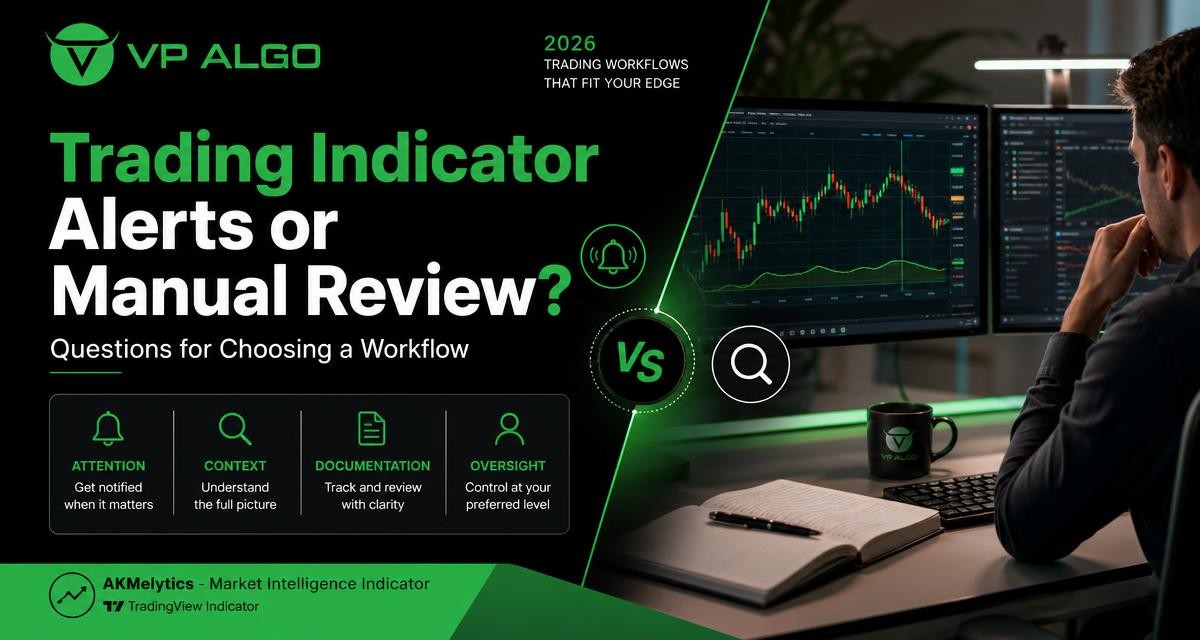
Choosing between trading indicator alerts and manual chart review is not simply a question of which method is faster. The better workflow depends on how you manage attention, how much context you need before reviewing a setup, and whether you prefer a prompt to investigate or a chart you examine from the ground up. A trading indicator can support either approach, but it should fit your decision process rather than replace it.
What is the difference between the two workflows?
An alert-led workflow begins with a notification or visible signal from a trading indicator. The alert draws attention to a chart, timeframe or condition that may deserve further review. Instead of watching every chart continuously, the trader uses the indicator to narrow the list of markets or moments requiring attention. The alert is therefore a starting point for analysis, not necessarily a completed trading decision.
A manual review workflow begins with the trader opening selected charts and examining them according to a repeatable process. That process may include trend direction, momentum, market structure, institutional activity, smart money conditions, and the relationship between multiple timeframes. Manual review can be slower, but it gives the trader direct control over what is examined and in what order.
| Workflow | How attention begins | Main strength | Main question to manage |
|---|---|---|---|
| Alert-led review | A trading indicator highlights a condition | Helps focus attention on selected situations | Does the alert provide enough context for a proper review? |
| Manual chart review | The trader opens and studies selected charts | Allows a broader, self-directed examination | Can the trader apply the process consistently without overlooking charts? |
| Hybrid workflow | Alerts identify candidates, followed by a checklist | Combines filtering with structured judgment | Is the follow-up process clear enough to avoid impulsive decisions? |
Question 1: How do you want to allocate attention?
Attention is limited, particularly when a trader follows several charts or reviews more than one timeframe. An alert-led process can reduce the need to keep every chart in view. When an indicator identifies a condition that matches the trader’s selected criteria, the trader can investigate that chart rather than repeatedly scanning an entire watchlist.
This does not mean alerts remove the need for observation. An alert may arrive at an inconvenient time, occur during a fast market move, or appear when the broader chart context does not support further interest. The useful question is whether the alert helps the trader direct attention more deliberately. If it encourages a calm review instead of an immediate reaction, it can become a practical part of the workflow.
When alerts may be useful
- When a trader follows a watchlist that is too large to inspect continuously.
- When a specific indicator condition is worth reviewing but not acting on automatically.
- When the trader wants a prompt to revisit a chart during a planned analysis period.
- When repeated scanning causes important chart observations to be missed.
When manual review may be preferable
- When the trader is learning how trend, momentum and structure appear on a chart.
- When the analysis requires a broad comparison across several instruments or timeframes.
- When the trader wants to follow a detailed checklist in the same order every time.
- When alerts would create too many interruptions or encourage rushed responses.
Question 2: Do you need a prompt or a complete context review?
A signal or alert usually represents a defined condition. It may draw attention to momentum, trend, market structure, institutional activity or another feature included in the trading indicator. That condition can be useful, but it is only one part of the chart. The trader still needs to ask what the broader market is doing and whether the highlighted feature has meaning in the current context.
Manual chart review makes context the centre of the process. A trader can begin with a higher timeframe, inspect the prevailing trend, review important structural areas and then move to a lower timeframe if that is part of the chosen method. This approach may provide a fuller narrative, although it also requires discipline to avoid selectively interpreting only the details that support an existing opinion.
Context questions for an alert
- What exact condition caused the trading indicator to draw attention to the chart?
- Is the condition visible on one timeframe or supported across multiple timeframes?
- What is the broader trend, and does the alert agree with or oppose it?
- What does current market structure suggest about the condition?
- Is momentum supporting the observation, weakening it or providing no clear confirmation?
- What information would make the setup unsuitable for further consideration?
These questions help preserve the distinction between an alert and a decision. An alert can identify a candidate for analysis, while context determines whether the candidate deserves more attention. This distinction is especially relevant for traders using a TradingView indicator as part of a wider technical-analysis routine.
Question 3: How important is documentation to your process?
Documentation allows traders to review how they reached a conclusion rather than relying on memory. In an alert-led workflow, the record can include the time of the alert, the condition that triggered it, the chart context observed afterwards and the reason for accepting or rejecting the candidate. In a manual workflow, the trader can document the stages of the review, including the trend assessment, structural observations and any conflicting evidence.
The best format is one that can be maintained consistently. A long journal template may appear thorough but become difficult to complete. A short checklist may be easier to use but omit details that matter to the trader’s method. The aim is not to create a perfect record for every chart; it is to create enough information to identify repeated habits, missed steps and differences between an initial observation and a later conclusion.
| Record to keep | Alert-led example | Manual-review example |
|---|---|---|
| Starting point | Time and condition associated with the alert | Reason the chart was selected for review |
| Market context | Trend and structure checked after the prompt | Higher- and lower-timeframe observations |
| Decision status | Reviewed, rejected, monitored or retained for later study | Review completed and outcome of the checklist |
| Reflection | Whether the alert was timely and informative | Whether the review was consistent and complete |
Question 4: How much oversight do you want?
Some traders prefer to be involved in every stage of chart interpretation. Others want a tool to reduce repetitive scanning while keeping the final review under their control. Neither preference is automatically better. The important point is to choose a workflow that matches the level of oversight the trader can maintain comfortably and consistently.
An indicator that combines several analytical features can present more than a single directional prompt. The Delphi Intelligence Smart Money Indicator offered by VP ALGO TRADING is described as including trend analysis, momentum signals, market structure, institutional flow monitoring, multi-timeframe trend assessment and smart money analysis. Used in an alert-led process, those features can give the trader several areas to examine after an alert. Used during manual review, they can help organise the questions applied to each chart.
The indicator remains an aid to evaluation. It does not remove the need for the trader to understand what is being displayed, decide which information is relevant and document the reasoning behind the review. A higher level of tool automation does not necessarily mean a lower level of personal responsibility.
Question 5: Can the workflow handle conflicting signals?
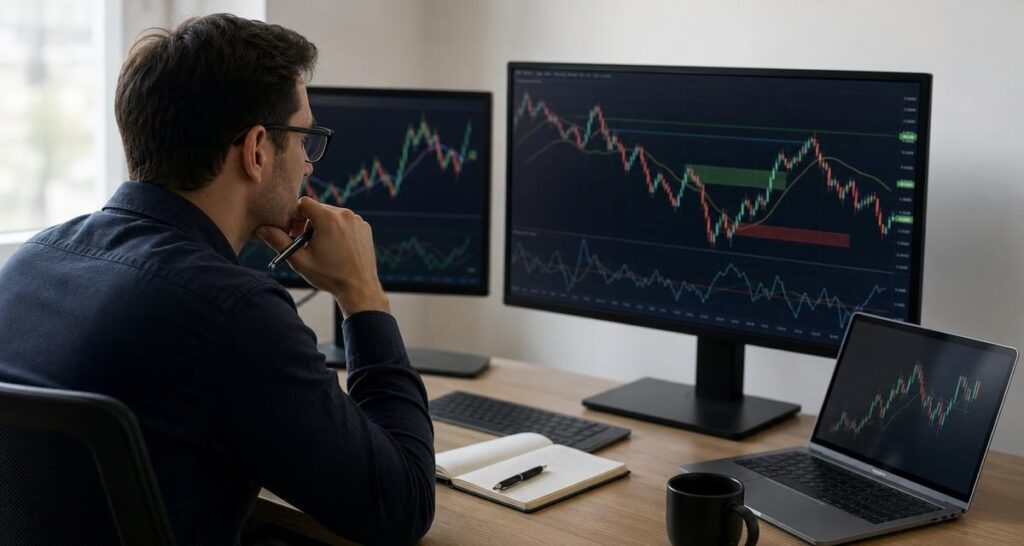
Conflicting information is normal in chart analysis. A trend assessment may point in one direction while momentum is weakening. Market structure may look constructive on one timeframe but less clear on another. An institutional-flow or smart-money observation may draw attention without resolving the full chart context.
An alert-led workflow should therefore include a response to disagreement. The trader might mark the chart for observation, wait for a clearer condition, or reject the candidate when the checklist does not align. A manual process needs the same discipline. Without a defined response, the trader may give excessive weight to the most recent signal or the feature that best supports a preferred view.
A practical conflict-review sequence
- Identify which features agree and which features disagree.
- Check whether the disagreement comes from different timeframes or different types of analysis.
- Return to the trader’s predefined criteria instead of choosing the most attractive signal.
- Record the uncertainty and decide whether the chart needs monitoring or can be set aside.
This approach keeps both alerts and manual reviews within a controlled process. It also makes the trader’s reasoning easier to evaluate later.
Question 6: Are you comparing speed with quality when the real issue is process design?
Alerts are often associated with speed, while manual review is associated with depth. That distinction is useful but incomplete. An alert can save time at the scanning stage and still require a detailed review afterwards. Manual review can be efficient when the trader uses a well-defined watchlist and checklist. The real comparison is between an unstructured process and a repeatable one.
A hybrid workflow may suit traders who want both filtering and oversight. The trading indicator can identify charts or conditions for review, while the trader applies a manual checklist before recording the result. This arrangement avoids treating every alert as a decision and avoids requiring constant manual scanning of every chart.
| Workflow design | Potential benefit | Potential weakness | Useful safeguard |
|---|---|---|---|
| Alerts only | Simple and attention-efficient | May provide too little context | Require a written review before any conclusion |
| Manual only | Direct control over chart selection | Can become time-consuming or inconsistent | Use a fixed watchlist and checklist |
| Alerts plus checklist | Filters attention while preserving oversight | Requires clear follow-up rules | Define what confirms, weakens or rejects a candidate |
How to choose a workflow for a TradingView indicator
Start by describing the decision you want the indicator to support. Are you trying to reduce watchlist scanning, organise chart observations, monitor trend changes, study momentum, or bring market-structure information into one review? A clear purpose makes it easier to judge whether alerts, manual analysis or a combination of both is appropriate.
Next, write a short review sequence before relying on the tool. For example, the sequence might begin with the higher-timeframe trend, continue with market structure and momentum, and end with a record of the evidence for and against further consideration. The exact sequence should reflect the trader’s own method. It should not imply that any indicator can predict future results or eliminate trading losses.
- Define what an alert means in your process: a prompt, a candidate or a condition for monitoring.
- Specify which timeframes and chart features must be reviewed afterwards.
- Decide how conflicting observations will be recorded.
- Set a limit on how many alerts you will review in one session.
- Keep notes on whether the workflow improves clarity and consistency.
For traders evaluating an indicator from VP ALGO TRADING, practical questions can also include how the TradingView product is installed, how access is activated and where to request usage assistance. The company states that customers provide their TradingView ID by email after purchase and can contact support for installation, activation or usage help. These operational details matter because a workflow is easier to assess when the trader understands how the tool will be used in practice.
Which workflow is the better choice?
There is no universal answer. Alert-led review may suit a trader who needs help directing attention across a broad watchlist. Manual review may suit someone who values a deliberate, bottom-up examination of selected charts. A hybrid process can be useful when the trader wants the indicator to filter candidates but still expects to verify trend, momentum, market structure and other relevant conditions personally.
The most reliable choice is usually the workflow that can be followed without rushing and documented without excessive effort. Treat the trading indicator as analytical support, define what an alert means, and make the final review process explicit. That approach allows the trader to compare workflows based on attention, context and oversight rather than assuming that more alerts or more manual analysis is automatically better.
Frequently Asked Questions
What is a trading indicator alert?
A trading indicator alert is a prompt associated with a defined chart condition. It directs attention to a chart or market situation for further review. It should not automatically be treated as a complete trading decision.
Is manual chart review better than using alerts?
Not necessarily. Manual review offers direct control and can provide broad context, while alerts can help organise attention. The better option depends on the trader’s watchlist, time available, preferred oversight and ability to follow a consistent process.
How should I evaluate a TradingView indicator alert?
Review the condition that triggered the alert, then check trend, momentum, market structure and relevant timeframes. Record whether the evidence supports further monitoring or whether the chart should be rejected from the current review.
Can a trading indicator replace chart analysis?
A trading indicator can organise information and draw attention to selected conditions, but it should not replace the trader’s understanding of the chart or the need for personal review. It is a decision-support tool rather than financial advice.
What is a hybrid alert and manual-review workflow?
It uses alerts to identify charts or conditions for attention, followed by a manual checklist. The trader remains responsible for reviewing context, handling conflicting information and recording the outcome.
What features can support a structured indicator review?
Trend analysis, momentum signals, market structure, multi-timeframe assessment, institutional activity and smart money analysis can provide areas for review when they are included in the indicator. The trader still needs to interpret those features within the chosen process.


Recent Comments