
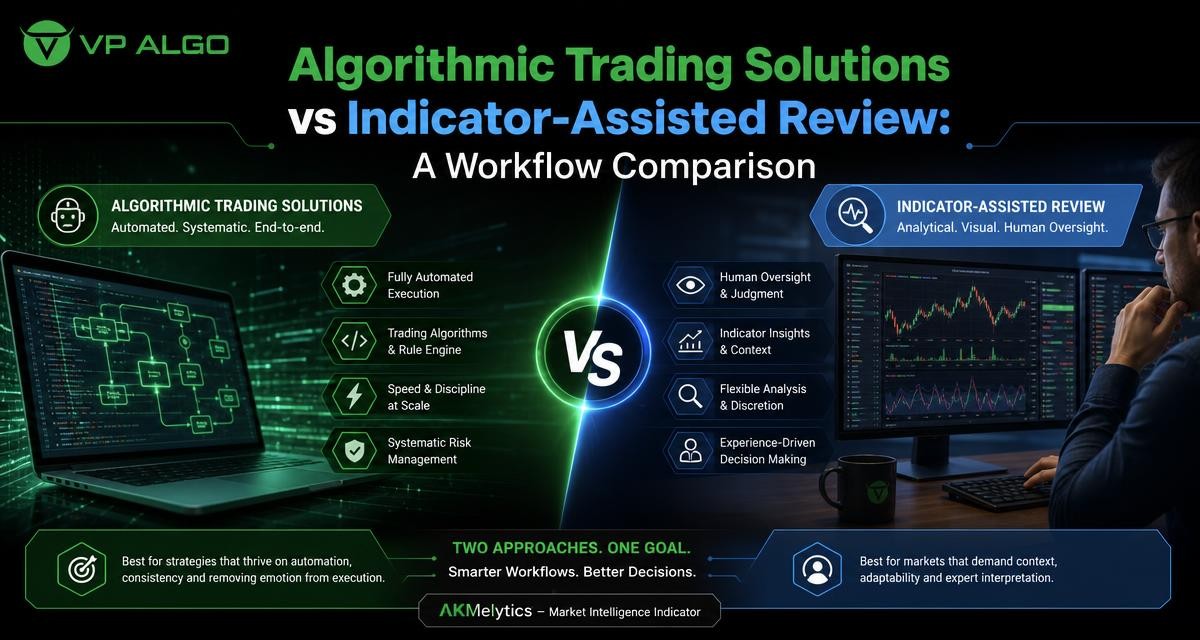
Algorithmic trading solutions and indicator-assisted review can both help traders bring more structure to market analysis, but they support different workflows. One focuses on applying predefined rules through software, while the other helps a trader interpret chart information and make decisions with human oversight. Understanding that distinction can make it easier to choose a suitable process for using TradingView tools, technical analysis and trading algorithms.
What algorithmic trading solutions usually mean
The phrase algorithmic trading solutions covers software-based systems that use defined instructions to process market information. Depending on the product, those instructions may be designed to identify conditions, generate alerts, rank opportunities or support the execution of a trading plan. The important point is that the logic is expressed in a repeatable, rule-based form rather than relying only on a trader’s moment-to-moment interpretation.
Automation exists on a spectrum. A tool may simply calculate signals from selected inputs, or it may form part of a larger workflow that includes data processing, alerts, order handling and monitoring. These functions should not be treated as interchangeable. An algorithm that highlights a condition on a chart is different from a system that independently manages the full process of entering and managing a position.
Typical characteristics of a rule-based workflow
- Inputs and conditions are defined in advance.
- The same logic can be applied repeatedly across reviewed charts or timeframes.
- Software performs calculations that may be difficult to track manually.
- Alerts or outputs can reduce the need to watch every price movement continuously.
- The trader remains responsible for understanding the system, reviewing its outputs and managing risk unless a separate automated execution process is involved.
Trading algorithms can therefore improve consistency without automatically making a trading process complete or appropriate for every situation. A ruleset still reflects the assumptions built into it, and an output still requires context.
What indicator-assisted chart review means
Indicator-assisted review places a trader in the centre of the decision process. A TradingView indicator can organise information such as trend direction, momentum, market structure or other chart conditions, allowing the user to assess a setup more systematically than by relying on a quick visual impression alone.
This approach is not necessarily manual in every detail. The indicator may calculate values, display conditions and bring relevant information together automatically. The distinction is that the software assists analysis rather than being presented as a substitute for the trader’s review. The user can consider the chart, the indicator output, the broader market context and the rules of a personal trading plan before deciding what to do.
Why traders use indicators during review
Charts can contain several layers of information at once. A trader may want to assess whether a market is trending, whether momentum supports that direction, how price has behaved around structural levels and whether other conditions are aligned. A market intelligence or smart money indicator may help organise some of these observations in one workspace.
VP ALGO TRADING develops and sells TradingView indicators and algorithmic trading tools intended to assist traders with market evaluation. Its indicator offering includes capabilities related to trend analysis, momentum signals, market structure, institutional activity, multi-timeframe trend assessment and smart money analysis. These tools are positioned for educational and trading-decision assistance, not as official financial advice.
Algorithmic trading solutions versus indicator-assisted review
The clearest difference is the point at which human judgement enters the workflow. A broader algorithmic solution may be designed to process rules and produce an output with limited intervention. Indicator-assisted review uses automation to prepare or organise information, while the trader interprets that information and decides how it fits the intended process.
| Workflow area | Algorithmic trading solutions | Indicator-assisted review |
|---|---|---|
| Primary role | Apply predefined logic to market data or trading conditions. | Help a trader evaluate chart information and potential setups. |
| Human involvement | May be limited during the calculation or alert stage, depending on the system. | Remains central to interpretation, confirmation and decision-making. |
| Analytical scope | Depends on the rules, data and functions built into the solution. | Can combine indicator output with the trader’s broader chart and market review. |
| Consistency | Applies defined rules in a repeatable way. | Provides repeatable information while leaving room for human context. |
| Flexibility | Changes require adjustments to rules, settings or software. | The trader can adapt the review process as new information appears. |
| Main responsibility | System design, testing, monitoring and appropriate use of outputs. | Interpreting the indicator, following a plan and managing decisions responsibly. |
Neither category should be judged solely by how automated it sounds. The more useful question is what the tool actually does. A product described as an algorithmic solution may be an analytical aid, an alert system or a more automated execution component. Likewise, an indicator may offer substantial calculations while still requiring the user to review the chart and make the final decision.
Comparing the workflows step by step
1. Data and inputs
Every workflow begins with inputs. Algorithmic systems use the data and conditions that their rules were designed to process. If a rule depends on trend, momentum or market structure, the quality and definition of those inputs affect the resulting output. The trader needs to understand which information the system uses and which information it does not use.
Indicator-assisted review follows the same principle, but the trader can place the displayed information alongside additional chart observations. For example, an indicator may highlight a trend or structural condition, while the user separately considers timeframe, recent price behaviour and whether the setup matches an existing trading strategy.
2. Signal or condition generation
A rules-based system may produce an alert when its specified conditions are met. This can be useful when a trader wants to monitor repeated conditions without manually checking every chart at all times. However, an alert is an output of the rules, not proof that a trade is suitable or that a particular outcome will follow.
With indicator-assisted review, the displayed signal or condition is one part of a wider assessment. The trader can ask whether the indication agrees with the broader chart structure, whether conflicting information is present and whether the setup falls within the limits of the trader’s plan.
3. Interpretation and confirmation
Interpretation is where the two workflows often diverge most. A highly automated process may move from a rule trigger to the next programmed action. An indicator-assisted process invites the user to examine why the condition appeared and whether it is meaningful in context.
Tools that bring together trend analysis, momentum evaluation, market structure and smart money concepts can support a more organised review. They do not remove the need to understand what each element represents. A trader should avoid treating several displayed elements as independent confirmation if they are derived from related inputs.
4. Decision and follow-through
After analysis, the user must decide how to proceed. In an indicator-assisted workflow, this may mean recording the setup, waiting for additional confirmation or choosing not to act. The indicator supports the decision process but does not turn an uncertain market into a certain one.
In a more automated workflow, follow-through may be determined by additional software rules. This makes system design and monitoring especially important. A trader needs to know what happens after an alert or condition, what remains manual and how unexpected market behaviour is handled.
Where indicator-assisted review can be useful
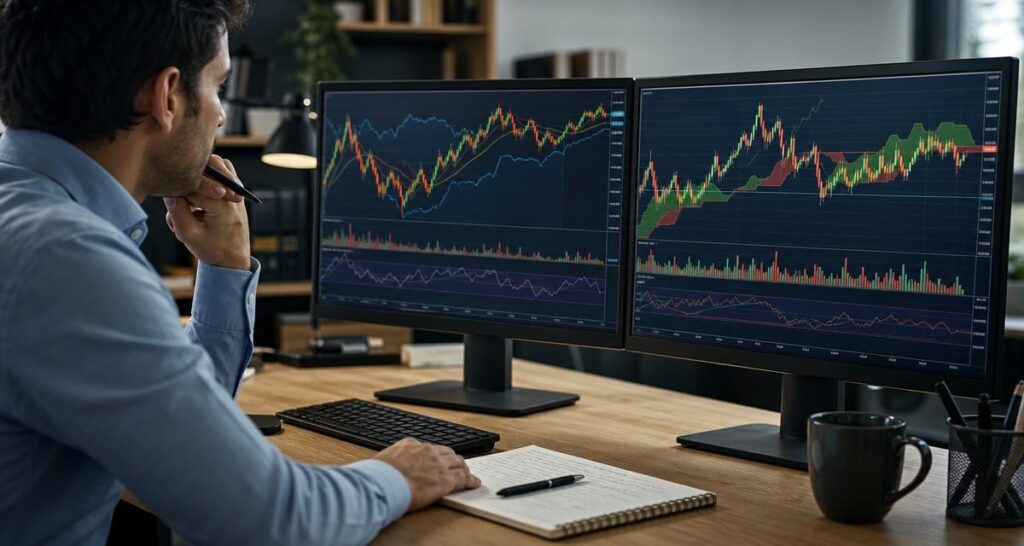
Indicator-assisted review can suit traders who want a repeatable way to organise technical analysis while retaining direct control over interpretation. It may be particularly useful for traders who review several dimensions of a chart and want those dimensions presented in a consistent workspace.
- Structured preparation: A trader can work through the same review areas instead of jumping between unrelated observations.
- Multi-factor analysis: Trend, momentum, market structure and smart money information can be considered as parts of one analytical process.
- Timeframe awareness: Multi-timeframe information can help the trader compare broader and more immediate chart conditions where the tool provides that function.
- Reduced visual clutter: A well-organised indicator may make selected conditions easier to identify than reviewing every calculation separately.
- Educational use: Seeing how different market observations appear on a chart can help users develop a more consistent review routine.
These benefits describe workflow support, not a promise of profitable results. Market decisions remain uncertain, and an indicator cannot eliminate losses or replace responsible risk management.
Where broader algorithmic solutions may fit
Algorithmic trading solutions may be appropriate when a trader wants to formalise a repeatable process. A clearly defined ruleset can reduce inconsistency caused by changing the method from one chart to another. It can also make it easier to review what a system is intended to do, provided the rules and assumptions are documented.
They may also help with monitoring or alerts when the trader cannot manually inspect every relevant condition. Still, greater automation creates additional questions: Which inputs are used? How are exceptions handled? What does the system do when conditions conflict? What remains under human control? These questions are more useful than assuming that more automation is automatically better.
Questions to ask before adopting a rules-based tool
- Does the tool analyse conditions, generate alerts or perform another function?
- Which market information and timeframes are included?
- Can the user understand the logic behind the displayed output?
- What decisions remain manual?
- How will the tool fit into an existing trading plan and review routine?
- What monitoring is needed when the tool is in use?
How to choose between the two approaches
The right choice depends on the trader’s objective. Someone developing a fully specified, repeatable process may be interested in algorithmic trading solutions that formalise rules and reduce manual monitoring. Someone who wants analytical structure while retaining discretion may prefer an indicator-assisted workflow on TradingView.
The choice does not have to be absolute. A trader can use algorithmic calculations or alerts to identify conditions, then perform a human-led chart review before deciding whether the information is relevant. This hybrid approach preserves the efficiency of rule-based processing while recognising that market context may require interpretation.
| If the priority is… | A suitable workflow question is… |
|---|---|
| Repeatable rule application | Can the software apply the intended conditions consistently? |
| Chart interpretation | Does the indicator help organise the information the trader actually reviews? |
| Reduced manual monitoring | What alerts or calculations can be automated without obscuring the logic? |
| Learning and oversight | Can the trader understand and question the tool’s output? |
| Process discipline | Does the workflow make it easier to follow a documented trading plan? |
Using a TradingView indicator responsibly
A TradingView indicator should be treated as part of a process rather than as a standalone answer. Begin by defining what the indicator is intended to help you review. Then decide which conditions must be present before a setup is considered, which observations are optional and which circumstances should lead you to wait.
It is also useful to keep a record of the reasoning behind a decision. This can reveal whether the indicator is being used consistently or whether the trader is selectively interpreting outputs after the fact. Such a record does not predict future results, but it can make the workflow easier to evaluate and improve.
VP ALGO TRADING states that its indicators are intended for educational and trading-decision assistance purposes. Customers who purchase its indicator are instructed to provide their TradingView ID by email for access, and support is available for installation, activation or usage assistance. The company also offers a request-based seven-day free trial for its indicator and Telegram channel, although users should confirm current availability and applicable conditions directly with the company.
Key takeaway
Algorithmic trading solutions and indicator-assisted review are related but not identical. Algorithmic tools emphasise predefined logic, repeatability and reduced manual processing. Indicator-assisted review uses calculations and visual organisation to help a trader assess conditions while keeping interpretation and decision-making in human hands.
For traders using TradingView, the most practical approach is to match the tool to the intended workflow. A market intelligence indicator can help structure analysis of trend, momentum, market structure and related conditions. Trading algorithms may help formalise rules or monitor repeated inputs. In either case, the tool should support a clearly understood process rather than replace independent review, risk awareness or responsible decision-making.
Frequently asked questions
Are algorithmic trading solutions the same as trading indicators?
No. A trading indicator usually helps calculate or display market information for review. Algorithmic trading solutions can include indicators, alerts or broader rule-based processes, so the exact function depends on the tool.
Does an indicator-assisted workflow require manual analysis?
Yes, in the sense that the trader remains responsible for interpreting the displayed information and deciding how it fits the trading plan. The indicator can automate calculations without making the entire decision process automatic.
Can a TradingView indicator replace a trading strategy?
An indicator is not automatically a complete strategy. It may support analysis of trend, momentum, market structure or other conditions, but the trader still needs a defined process for review, decision-making and risk management.
Are automated alerts the same as automated trade execution?
No. An alert informs the user that programmed conditions may have appeared. Automated execution is a separate function that involves additional rules and software behaviour.
What should traders compare when reviewing algorithmic tools?
Compare the tool’s inputs, rules, outputs, level of automation, timeframe handling and required human oversight. Also check whether the tool’s purpose matches the workflow you intend to use.
Can algorithmic tools and indicators be used together?
Yes. A trader may use rule-based calculations or alerts to identify conditions and then apply indicator-assisted chart review before making a decision. The roles of each tool should remain clear.
Do these tools guarantee profitable trading results?
No. Neither algorithmic trading solutions nor indicators can guarantee profits or eliminate losses. They are tools for analysis and workflow support, and market outcomes remain uncertain.


Recent Comments