
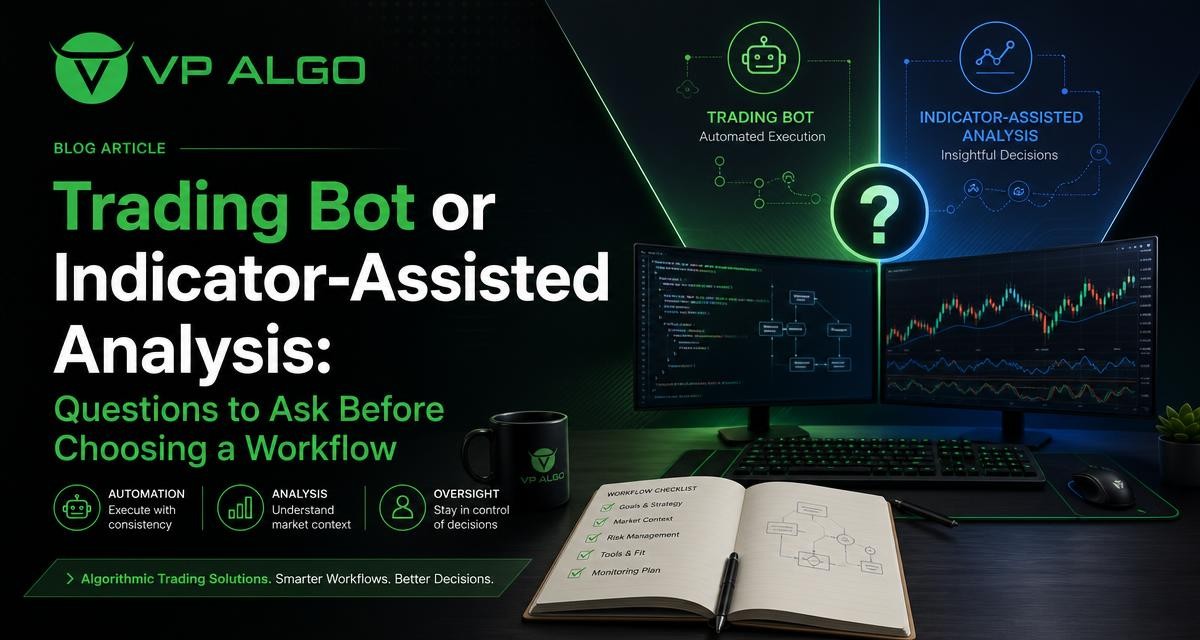
Choosing between a trading bot and indicator-assisted analysis is not simply a choice between automation and manual trading. The more useful question is how much of your workflow should be handled by software, where human judgment remains necessary, and how market context will be evaluated before a decision is made. A trading bot may automate defined instructions, while an indicator can help structure the analysis that precedes a trade. Understanding that difference makes it easier to assess algorithmic trading solutions without assuming that more automation is automatically better.
What is the difference between a trading bot and an indicator?
A trading bot is software designed to follow predefined rules for actions such as monitoring conditions, generating alerts, or placing and managing trades, depending on how it is built and connected to a trading environment. Its central purpose is automation. Once its rules and operating conditions are set, the bot can carry out a process with limited intervention.
An indicator is primarily an analysis tool. It processes price or other available market information and presents calculations, signals, visual markers, or contextual readings on a chart. The trader then interprets that information as part of a broader decision. An indicator may support technical analysis, but it does not necessarily execute a trade.
| Question | Trading bot | Indicator-assisted analysis |
|---|---|---|
| Main role | Automate defined actions or decisions | Organize information for human analysis |
| Human involvement | May be limited after configuration, depending on the system | Usually remains central to interpretation and execution |
| Market context | Depends on the rules and data included in its design | Can be reviewed alongside chart structure and other evidence |
| Primary concern | Rule accuracy, execution conditions and monitoring | Interpretation, consistency and decision discipline |
| Typical output | Automated actions, alerts or rule-based decisions | Signals, readings, chart context or visual analysis aids |
The distinction matters because a tool that highlights a possible setup is not the same as a system that acts on it. Confusing those roles can lead to unrealistic expectations, especially when a trader treats an analytical signal as an automatic instruction.
Question 1: What part of the workflow do you want to improve?
Start with the practical problem rather than the product category. Some traders struggle to monitor charts consistently. Others find it difficult to organize several forms of technical analysis, compare market conditions across timeframes, or follow a written plan without reacting emotionally. These are different problems and may call for different tools.
A trading bot may be relevant when the objective is to automate a clearly defined, repeatable process. An indicator-assisted workflow may be more suitable when the trader wants structured information but still needs to assess context before deciding what to do. If the rules are not clear enough to explain in plain language, automating them may simply make an unclear process operate faster.
- Use a bot-oriented evaluation when repeatable execution is the main concern.
- Use an indicator-oriented evaluation when chart interpretation and consistency are the main concerns.
- Consider a staged workflow when you need structured analysis before deciding whether automation is appropriate.
Question 2: How much oversight should remain with the trader?
Oversight is not a sign that a tool has failed. It is part of responsible workflow design. A trader should know which conditions a system evaluates, what information it ignores, and when manual review is required. This is particularly relevant when markets change character or when a chart presents conflicting evidence.
With a trading bot, oversight may involve checking whether the rules are operating as intended, whether connections and settings remain correct, and whether the surrounding trading conditions still match the original plan. With an indicator, oversight usually focuses on interpreting its readings, checking for confirmation, and deciding whether a potential setup fits the trader’s rules.
Questions to ask about oversight
- What does the tool do automatically, and what does it leave to the user?
- Can you explain the conditions behind an alert or action?
- How will you review the tool during unusual or rapidly changing market conditions?
- What is your process if the tool produces a reading that conflicts with the broader chart?
- How often will settings, assumptions and operating conditions be reviewed?
Question 3: Does the tool account for market context?
A signal rarely tells the whole story. Trend direction, momentum, market structure, institutional activity and smart money concepts may all form part of a trader’s assessment, but no single reading should be treated as a complete description of market conditions. The relevant context depends on the trader’s method, timeframe and decision rules.
This is one reason traders may evaluate a market intelligence indicator such as AKMelytics – Market Intelligence Indicator as part of an indicator-assisted workflow. The useful question is not whether an indicator can replace judgment. Instead, ask whether it helps you review the types of information that matter to your process in a more organized and repeatable way.
VP ALGO TRADING develops and sells TradingView indicators and algorithmic trading tools. Its business knowledge describes tools that relate to trend analysis, momentum signals, market structure, institutional flow monitoring, multi-timeframe trend assessment and smart money analysis. Those categories can help a trader define what to investigate, but they should still be connected to a personal trading plan and risk process.
Context is different from prediction
Market context can improve the quality of a review without predicting what will happen next. An indicator may identify a condition or draw attention to an area of the chart, but that does not guarantee a particular outcome. Traders should distinguish between information that supports analysis and a promise of profitable results.
Question 4: Are the rules clear enough to automate?
Automation requires precise instructions. A trader may describe a strategy informally as “buy when momentum is strong and the trend looks positive,” but a bot needs more specific definitions. Which momentum measure is being used? What qualifies as strong? Which timeframe applies? What happens when the trend and momentum readings disagree?
Before choosing a trading bot, write the workflow as a sequence of observable conditions. Include the entry logic, exit logic, invalidation conditions, monitoring requirements and situations in which no action should be taken. If several parts of the process rely on judgment, an indicator-assisted workflow may be more realistic than full automation.
- Describe the market condition you want to identify.
- Define the data, timeframe and indicators used in the assessment.
- State what confirms or invalidates the setup.
- Separate an analytical signal from an execution instruction.
- Document when manual review is required.
Question 5: How will you handle conflicting signals?
Real charts do not always provide neatly aligned information. A trend reading may appear constructive while momentum weakens. Market structure may suggest caution while a shorter timeframe displays a possible continuation. A workflow should explain how these conflicts are handled instead of assuming that every signal will agree.
For an indicator-assisted approach, conflicting readings can become a prompt for further review. A trader might compare timeframes, examine recent structure, or wait for a defined confirmation. For a bot, conflict handling must be encoded in advance. If the rules do not say what happens when conditions disagree, the system may behave in a way the trader did not intend.
| Situation | Indicator-assisted response | Bot design question |
|---|---|---|
| Trend and momentum disagree | Review the timeframe and wait for the trader’s defined confirmation | Which condition has priority, or should the system take no action? |
| Market structure changes | Reassess whether the original setup is still valid | What event invalidates the rule set? |
| Signals appear across different timeframes | Use a stated hierarchy for timeframe analysis | Which timeframe controls the decision? |
| Data or platform conditions change | Pause analysis and check the information source | What is the system’s fail-safe or pause condition? |
Question 6: What does “automation” actually include?
The word automation can describe several different functions. A tool may scan charts, produce an alert, display a signal, send information to another system, or execute an order. These functions should not be treated as interchangeable. Before selecting a product, identify the exact level of automation being offered and whether it matches your intended workflow.
TradingView indicators are generally associated with chart-based analysis and alerts, while a trading bot may involve additional systems for execution and monitoring. The existence of a signal or alert does not by itself establish that a trade will be placed, managed or closed automatically. Ask for a clear description of the tool’s role rather than relying on broad language about artificial intelligence or algorithmic trading.
Question 7: How will you manage risk and operational issues?
Risk management is separate from signal generation. A bot can follow rules consistently, but consistency does not make a rule set suitable for every condition. An indicator can organize analysis, but it cannot remove market risk. The trader remains responsible for defining acceptable exposure, reviewing assumptions and understanding how the workflow operates.
Operational questions matter as well. Consider how you will handle incorrect settings, interruptions, stale information, connection problems, duplicate actions or an unexpected market environment. The more responsibility a system takes on, the more clearly these issues should be documented and monitored.
- Define when trading activity should be paused.
- Keep a written record of the strategy rules and configuration.
- Review alerts and actions rather than assuming they are correct.
- Separate a tool’s analytical function from your personal risk decisions.
- Avoid treating historical behavior or past results as a guarantee of future performance.
When an indicator-assisted workflow may be the better starting point
An indicator-assisted workflow can be a practical starting point when a trader wants more structure without handing every decision to automation. It may help organize a review of trend, momentum, market structure and related market information, while leaving the trader responsible for interpretation and execution.
This approach can also make a strategy easier to explain. Instead of reacting to an isolated buy or sell label, the trader can ask whether the broader conditions align with the plan. That does not make the process risk-free, and it does not guarantee better results. It simply creates a clearer separation between gathering information and making a decision.
When a trading bot may deserve consideration
A trading bot may deserve consideration when the workflow is specific, repeatable and sufficiently defined to be translated into rules. The trader should understand what the bot can do, what it cannot do, how it will be monitored and how it will respond to conditions outside the original assumptions.
Automation should be evaluated as an operational commitment, not as a shortcut to certainty. A bot may reduce the need for manual repetition, but it does not remove the need to review the system, its inputs and its logic. If the strategy depends heavily on interpretation of market context, an indicator may remain an important part of the process even when some actions are automated.
A practical decision framework
Use the following sequence before choosing between a trading bot and indicator-assisted analysis:
- Define the decision. Are you trying to find setups, receive alerts, execute rules or manage an existing process?
- List the evidence. Identify the trend, momentum, structure and other market information your method requires.
- Separate judgment from repetition. Keep contextual decisions manual if they cannot be defined clearly.
- Specify oversight. Decide when you will review readings, alerts, configurations and system behavior.
- Test understanding before reliance. You should be able to explain why the workflow produces an alert or action.
- Review the tool’s actual scope. Confirm whether it provides analysis, alerts, execution or a combination of clearly described functions.
For traders using TradingView, a market intelligence indicator can fit into the evidence-gathering stage of this process. The goal is to create a repeatable review, not to outsource responsibility for every trading decision. VP ALGO TRADING positions its indicators for educational and trading-decision assistance rather than as financial advice, which is an important distinction when assessing any tool.
Final considerations before choosing
The right comparison is not “manual trading versus complete automation.” A better comparison is between different ways of structuring decisions. A trading bot emphasizes rule-based action and operational consistency. Indicator-assisted analysis emphasizes organized information, chart context and human interpretation.
Before committing to either workflow, ask whether the tool matches your actual problem, whether its role is clearly defined, and whether you can monitor it responsibly. A well-understood indicator may be more useful than an automated system whose rules you cannot explain. In other cases, carefully specified automation may reduce repetitive work. The decision should follow the workflow, not the marketing label.
Frequently asked questions
Is a trading bot the same as a trading indicator?
No. A trading bot is designed to automate defined actions or decisions, while a trading indicator presents information, signals or chart analysis for interpretation. Some workflows may use both, but they serve different roles.
Can an indicator execute trades automatically?
Not necessarily. An indicator may display readings or generate alerts without placing or managing trades. Confirm the exact functions of the product before assuming that analysis is connected to execution.
Should beginners start with a trading bot?
There is no universal answer. Beginners may benefit from first understanding the rules behind a workflow and how market context is assessed. Automation should follow clear, understood rules rather than replace that understanding.
What should I ask before buying a TradingView indicator?
Ask what information it presents, how it fits into your analysis, what level of automation it provides, what support is available for installation or use, and which decisions remain your responsibility.
Can a smart money indicator guarantee profitable trades?
No. A smart money indicator can be used as an analysis aid, but it cannot guarantee profits, eliminate losses or predict future market results.
Is algorithmic trading risk-free when the rules are automated?
No. Automation can apply rules consistently, but market, technical and operational risks remain. A trader should understand the rules, monitor the system and maintain a separate risk process.
How does AKMelytics fit into this comparison?
AKMelytics – Market Intelligence Indicator can be evaluated as an indicator-assisted analysis tool. Consider whether its information fits your TradingView workflow and helps you review market conditions without treating its readings as financial advice or automatic guarantees.


Recent Comments