
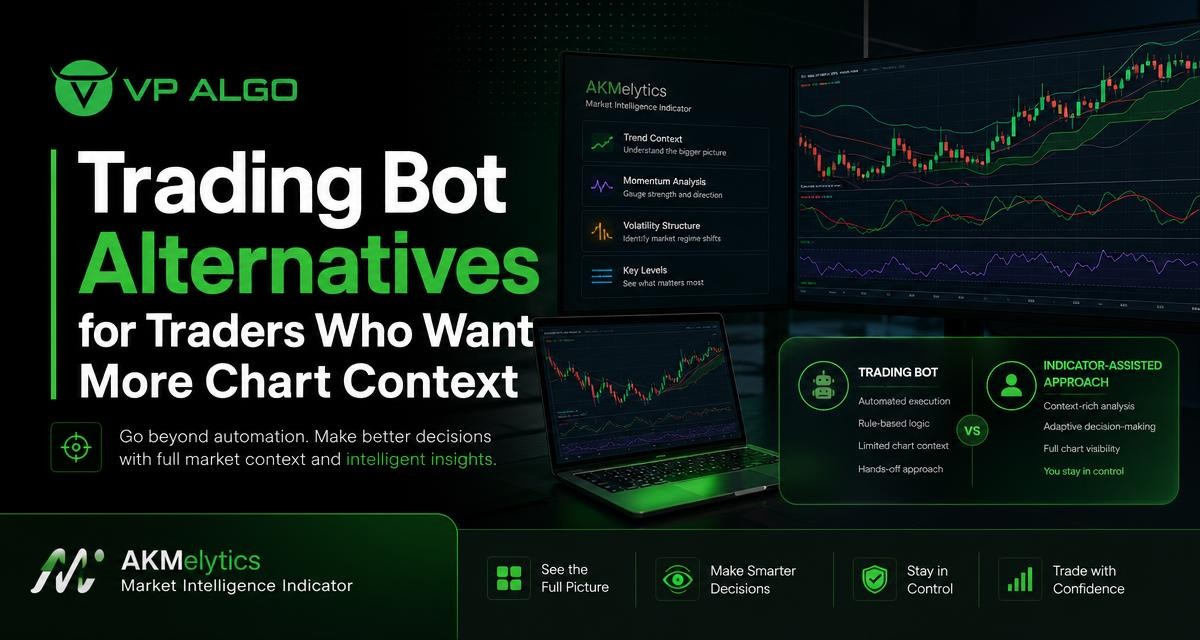
A trading bot can automate parts of a trading process, but automation is not the only way to use technology in market analysis. Some traders want more context before deciding whether a setup deserves attention. They may prefer to review trend, momentum, market structure, institutional activity and smart money conditions on a chart, then retain responsibility for the final decision. For those traders, an indicator-assisted approach can be a practical alternative to relying on a trading bot alone.
Why some traders look beyond a trading bot
The appeal of a trading bot is easy to understand. A bot may be designed to follow predefined rules, monitor conditions and handle parts of execution according to its configuration. This can reduce the need to watch charts continuously and can make a process more systematic.
However, automation and understanding are different objectives. A fully automated process may focus on whether a rule has been met, while a discretionary trader may also want to understand the surrounding market environment. Is the broader trend aligned with the current movement? Is momentum strengthening or weakening? Has market structure changed? Are there signs that help explain why a setup is appearing?
These questions do not automatically make manual trading better or safer. They simply reflect a different preference for oversight. A trader who wants to assess the reasoning behind a potential setup may be more interested in a TradingView indicator that organizes chart information than in a system that acts without further review.
Trading bot automation versus indicator-assisted evaluation
A trading bot and a market intelligence indicator can both be associated with trading algorithms, but they usually support different stages of a workflow. A bot is generally connected with rule-based automation or execution. An indicator displays calculated information on a chart to help the trader interpret conditions.
| Approach | Primary role | Level of trader oversight | Useful question |
|---|---|---|---|
| Trading bot | Automates actions according to configured rules | Often lower during the active process, depending on the setup | Have the programmed conditions been met? |
| Standalone indicator | Displays selected market information or signals | Higher, because the trader interprets the chart | What is happening in the broader market context? |
| Indicator-assisted workflow | Combines structured analysis with a manual decision process | Shared between tools and the trader | Does this setup fit the current trend, structure and momentum? |
The distinction matters when choosing algorithmic trading solutions. A trader may not be looking for a system to make every decision. Instead, the goal may be to reduce chart clutter, organize several forms of analysis and create a repeatable review process while keeping manual oversight.
What “more chart context” means in practice
Chart context is the information surrounding a possible entry or exit idea. A single buy or sell signal rarely explains the complete market picture. Traders often want to consider several factors together rather than treat one alert as a complete trading plan.
Trend direction
Trend analysis helps a trader frame the current movement. A trend indicator for TradingView may be used to examine whether price action appears to be moving in a sustained direction, losing strength or changing character. This does not determine what will happen next, but it can provide a broader reference point for evaluating a setup.
Momentum
Momentum analysis focuses on the strength or weakness behind a price move. A momentum indicator for TradingView can help place a possible signal in context. For example, a trader may want to distinguish between movement that is gaining participation and movement that appears to be slowing. The interpretation still depends on the chart, timeframe and the trader’s process.
Market structure
Market structure concerns the way price forms highs, lows, breaks and other changes in its behavior. A market structure indicator can help traders inspect these developments without relying only on isolated candlestick patterns. Structure may be especially useful when a trader wants to ask whether a move represents continuation, a possible transition or an area requiring caution.
Institutional activity and smart money concepts
Some traders also study institutional activity and smart money concepts as part of their market review. These ideas can be difficult to organize when viewed across a busy chart. A smart money indicator may bring related observations into one analytical view, while still leaving the trader to assess whether the information is relevant to the current setup.
How the AKMelytics Market Intelligence Indicator fits this approach
VP ALGO TRADING offers the AKMelytics – Market Intelligence Indicator for TradingView. Its intended role is to help traders evaluate market conditions and potential trading setups through a combination of trend analysis, momentum evaluation, market structure, institutional activity and smart money analysis.
This makes it different from treating a trading bot as the sole decision-maker. The indicator is designed to support chart-based evaluation. A trader can use the information to develop a structured review of the market, compare conditions across the chart and decide whether a possible setup fits their own trading plan. It is not presented as a financial adviser or as a replacement for individual judgment.
The indicator also includes multi-timeframe trend assessment. Looking at more than one timeframe can help a trader consider whether a short-term movement sits within a broader trend or conflicts with it. Multi-timeframe information should still be interpreted carefully; alignment across timeframes does not guarantee a particular market outcome.
When an indicator may suit you better than a trading bot
An indicator-assisted workflow may be worth considering if your main challenge is interpreting market information rather than placing orders automatically. It can be a better fit for traders who want to remain involved in the review process and prefer to understand why a chart is being highlighted.
- You want to review context before acting: An indicator can bring several analytical factors into the same chart view for further assessment.
- You use a discretionary or semi-systematic process: Structured information can support consistency without forcing every decision into a fully automated rule set.
- You are learning technical analysis: Seeing trend, momentum and structure together may help you build a more organized review habit.
- You want to compare timeframes: Multi-timeframe trend assessment can add another layer to the chart review.
- You do not want to treat one signal as a complete answer: An indicator can be used as one input among several rather than as an automatic instruction.
None of these points means that an indicator will remove uncertainty. Markets can behave unexpectedly, and an organized chart does not eliminate losses or the need for risk management. The benefit is mainly process-related: the tool can help make certain areas of analysis easier to review.
When a trading bot may be the preferred tool
A trading bot may be more appropriate for a trader whose main objective is rule-based automation. Someone with a clearly defined strategy may want software to monitor conditions and manage specified actions according to that strategy. In that case, the key considerations include how the rules are defined, how the system is monitored and whether the trader understands its limitations.
Automation does not remove the need for oversight. A trader still needs to understand the bot’s configuration, the assumptions behind its rules and the circumstances in which its behavior may not match expectations. Technical problems, changing market conditions or an unsuitable strategy can affect the usefulness of an automated approach.
The central choice is therefore not simply “bot versus indicator.” It is a question of where you want technology to support your process: execution, analysis or both. Some traders may use an indicator for market evaluation and then apply their own manual process. Others may use broader analysis first and reserve automation for a later stage. The appropriate arrangement depends on the trader’s objectives and experience.
A practical framework for choosing between the two
1. Define the decision you want the tool to support
Start by identifying the problem. Are you spending too much time monitoring charts? Or are you struggling to organize trend, momentum and structure before making a decision? The first problem may point toward automation, while the second may point toward an indicator-assisted workflow.
2. Decide how much manual control you want
Consider whether you want a tool to display information, generate a rules-based signal or take action after conditions are met. The more responsibility assigned to software, the more important it becomes to understand its configuration and monitor how it behaves.
3. Check whether the information matches your analysis style
A tool is most useful when the information it provides is relevant to your process. If you study trend, momentum, market structure and smart money concepts, a market intelligence indicator that brings these areas together may be more suitable than a tool focused only on execution.
4. Create rules for interpretation
Before using any signal or chart feature, decide how you will interpret it. For example, you might require a potential setup to be reviewed against the broader trend, current momentum and recent market structure. These are examples of process questions, not universal trading rules.
5. Keep risk management separate from the tool
A trading indicator or trading bot does not replace a risk management plan. Position sizing, exposure, trade frequency and exit decisions require careful consideration. No indicator can guarantee profitable results or eliminate trading losses.
Using a TradingView indicator with appropriate expectations
The AKMelytics Market Intelligence Indicator is intended for TradingView and supports educational and trading-decision assistance purposes. Traders considering it should approach it as an analytical aid rather than as a promise of a particular outcome. Its information can be reviewed alongside a trader’s own market research, strategy and risk controls.
VP ALGO TRADING provides a request-based 7-day free trial for its indicator and Telegram channel. Customers who purchase the indicator are instructed to provide their TradingView ID by email for access. Support is available for installation, activation or usage assistance, according to the supplied business information. These access steps are separate from the question of whether the indicator fits a trader’s preferred workflow.
Questions to ask before choosing algorithmic trading solutions
Before selecting a trading bot, indicator or combined workflow, ask practical questions about how the tool will be used. Does it provide information you can interpret? Does it fit your level of involvement? Can you explain what a signal means within your own process? Are you prepared to monitor the tool and review its limitations?
These questions help prevent a common mistake: choosing technology because it sounds more advanced rather than because it solves a clearly defined problem. More automation is not automatically more useful, and more chart information is not automatically better. The strongest choice is the one that supports a disciplined process you understand.
FAQ
Is an indicator the same as a trading bot?
No. An indicator displays calculated market information to support analysis, while a trading bot is generally associated with rule-based automation or execution. They can be used at different stages of a trading workflow.
Can the AKMelytics indicator place trades automatically?
The supplied information describes AKMelytics as a market intelligence indicator for TradingView that supports market evaluation and potential setup analysis. It does not establish that the indicator automatically places trades.
What kind of chart context does AKMelytics provide?
The indicator includes features related to trend analysis, momentum evaluation, market structure, institutional activity, multi-timeframe trend assessment and smart money analysis.
Is the indicator financial advice?
No. VP ALGO TRADING positions its indicators as tools for educational and trading-decision assistance purposes, not as financial advice or personalized investment guidance.
Does more chart context guarantee better trading results?
No. Additional information can support a more structured review, but it cannot guarantee profits, predict future results or eliminate trading losses. Traders remain responsible for their decisions and risk management.
Who might prefer a trading bot alternative?
Traders who want to inspect trend, momentum, market structure and related conditions before making a decision may prefer an indicator-assisted workflow. It can provide structured information while preserving more manual oversight.


Recent Comments