
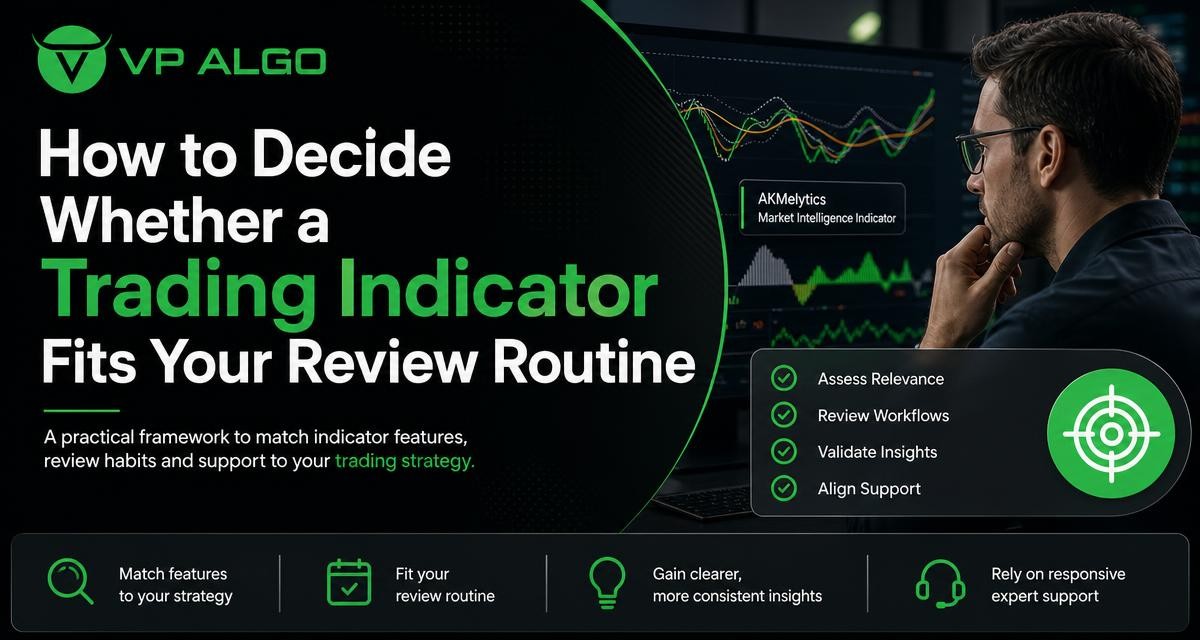
Choosing a trading indicator is less about finding the most impressive-looking chart tool and more about finding one that fits the way you already review markets. A useful trading indicator should help you examine relevant information, reduce unnecessary chart switching and support a consistent decision-making process without replacing your own analysis.
Start with your review routine, not the indicator’s feature list
Many traders begin by comparing screenshots, signal labels or long lists of functions. That can be useful later, but the first question is simpler: what do you actually review before forming a market view? Your routine may involve trend direction, momentum, market structure, institutional activity, multiple timeframes or smart money concepts. It may also be much more focused, such as checking whether price is moving with or against a broader trend.
A trading indicator is more likely to be useful when its information matches that routine. If you rarely study momentum, a tool with extensive momentum-related features may add visual noise rather than clarity. If you regularly compare several timeframes and assess structure before looking for a setup, features that support those tasks may be more relevant than a basic buy-and-sell label.
Write down the questions you want your chart to answer
Before exploring a service, list the questions you ask during a normal review. For example, you might want to understand whether the current trend is strengthening, whether momentum supports the move, whether market structure has changed, or whether activity associated with larger market participants deserves further attention.
This exercise creates a practical filter. Instead of asking whether an indicator is “the best,” you can ask whether it contributes useful information to the questions you already consider. It also helps you identify gaps in your process without assuming that every gap needs to be filled by another chart tool.
- What is the broader trend on the timeframes you review?
- How do you assess momentum or weakening movement?
- Which market structure events matter to your analysis?
- Do you review institutional activity or smart money conditions?
- How do you record and revisit your observations?
Match indicator features to your analysis needs
VP ALGO TRADING develops trading indicators and algorithmic trading tools for TradingView. Its AKMelytics – Market Intelligence Indicator is intended for traders who want a more structured way to evaluate market conditions. The relevant feature areas associated with the company’s indicator offering include trend analysis, momentum evaluation, market structure, institutional activity, multi-timeframe trend assessment and smart money analysis.
Those categories can be useful starting points, but a feature only matters when you understand how it fits into your process. A trend-related view might help you frame market direction. Momentum information can add context about the strength or loss of strength behind a move. Market structure can help organise observations about breaks, shifts or important price behaviour. Institutional activity and smart money analysis may provide another layer for traders who already use those concepts in their reviews.
Assess the feature areas individually
| Feature area | What it may help you review | What to clarify before relying on it |
|---|---|---|
| Trend analysis | Direction and broader market context | Which timeframe matters to your routine and how you interpret conflicting views |
| Momentum evaluation | Strength, persistence or weakening movement | Whether momentum confirms your process or simply adds another visual signal |
| Market structure | Changes in price behaviour and structural context | Which structure concepts are relevant to your trading strategies |
| Institutional activity | Additional context about activity you want to monitor | How the information is defined and how it should be interpreted |
| Multi-timeframe assessment | Comparison of broader and nearer-term conditions | Whether it fits the timeframes you actually review |
| Smart money analysis | Organisation of smart money concepts within a chart review | How it complements, rather than replaces, independent analysis |
The table is not a promise that any one feature will produce a particular result. It is a checklist for deciding whether the information is relevant. A service is easier to evaluate when you can connect each feature to a defined step in your review rather than treating the entire feature list as one undifferentiated benefit.
Consider how the indicator changes your workflow
A trading indicator should be judged by how it fits into a repeatable workflow, not only by what appears on the chart. Think through the sequence you normally follow. You might begin with a higher-timeframe view, inspect trend and momentum, study market structure, compare a nearer-term chart and then document why a setup is or is not worth further review.
Ask where the indicator would enter that sequence. Does it help you form context at the beginning? Does it offer a way to organise information you currently gather manually? Does it create a final confirmation step? Or would it encourage you to wait for a label without understanding the market conditions behind it?
Use a simple before-and-after review
Take one ordinary chart review and describe it without the indicator. Record the timeframes, observations and decisions you make. Then imagine using the tool and identify what would change. The most useful change is usually specific: fewer separate checks, clearer organisation of information or a more consistent way to compare conditions.
Be cautious if the only perceived improvement is that the chart looks busier or that the tool produces more alerts. More information does not automatically create better analysis. A well-fitting indicator should make your process easier to understand, not make you dependent on unexplained prompts.
- Define the market questions you review before considering a setup.
- Identify which questions the indicator is designed to support.
- Decide where its information belongs in your existing workflow.
- Separate context from any signal or visual prompt.
- Record what you observed and whether the tool made the review clearer.
Check whether the tool suits your experience level
Beginners and experienced market participants can both use structured chart tools, but they may need different things from them. A beginner may value a clearer framework for learning how trend, momentum and market structure relate to one another. An experienced trader may be more concerned with reducing repetitive chart checks or bringing several analytical categories into one review.
Neither use case makes the indicator automatically suitable. Beginners should avoid treating a visual label as a substitute for learning the underlying concepts. More experienced traders should check whether the tool adds useful context to an established method rather than duplicating information they already interpret effectively.
Questions for newer traders
- Can you explain what each major feature is intended to show?
- Do you know which parts are context and which parts are prompts for further review?
- Are you prepared to compare the indicator’s information with your own chart reading?
- Will the tool help you learn a process, or are you expecting it to make decisions for you?
Questions for experienced traders
- Does the indicator complement your existing trading strategies?
- Does it help you compare multiple timeframes without changing your core rules?
- Can you explain what new information it contributes?
- Does it reduce repeated work, or does it introduce additional signals to reconcile?
Be realistic about indicator-assisted analysis
An indicator can organise information and support a more consistent review, but it cannot remove uncertainty from markets. Trend, momentum, structure and activity-based observations still require interpretation. Conditions can conflict, a setup can fail to develop as expected, and a chart tool cannot guarantee a particular outcome.
VP ALGO TRADING positions its indicators for educational and trading-decision assistance purposes rather than as financial advice. That distinction matters when deciding whether a service is right for you. The appropriate expectation is assistance with analysis, not a promise of profitable results, risk-free trading or the elimination of losses.
Use a trading indicator as part of a review process you understand. Do not treat it as a replacement for independent judgment, risk awareness or a clearly defined trading plan.
It is also worth separating a tool’s capabilities from the trading strategies you may use with it. The same indicator may be reviewed differently by two traders because their timeframes, rules and objectives are different. The product does not automatically determine a suitable strategy, market or trade decision for every user.
Evaluate multi-timeframe relevance
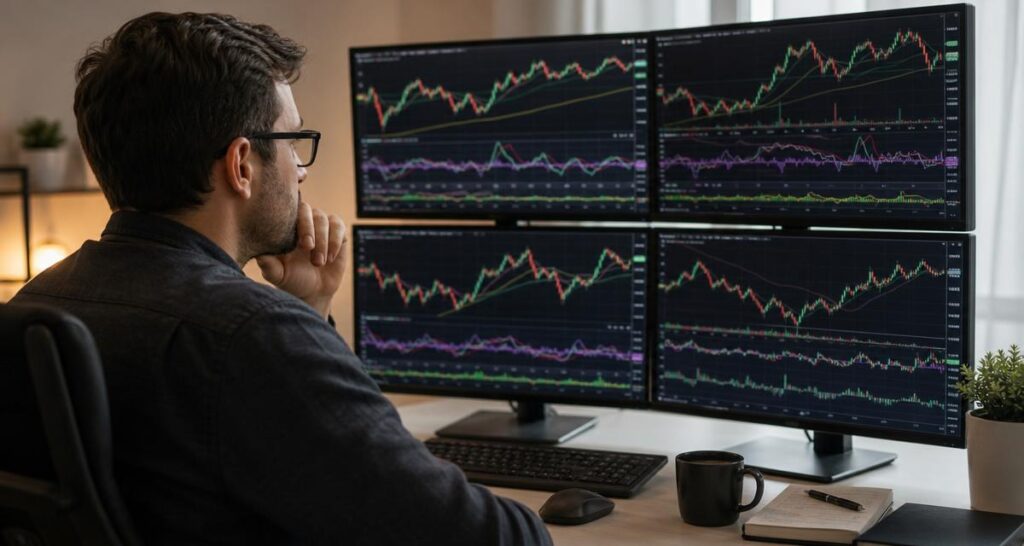
Many traders want to understand broader conditions before examining a nearer-term chart. A multi-timeframe trend assessment feature may be relevant if that is already part of your routine. For example, you may review a broader trend first and then look at shorter-term momentum or structure for additional context.
The key is to define the role of each timeframe. A higher timeframe can provide context, while a lower timeframe may show more immediate price behaviour. However, simply displaying several timeframes does not resolve disagreement between them. Decide in advance how you will interpret conflicting information and which observations carry more weight in your process.
| Review stage | Useful question | Potential mistake |
|---|---|---|
| Broader context | What general trend or condition am I reviewing? | Assuming broad direction determines every nearer-term move |
| Intermediate structure | Has price behaviour changed in a meaningful way? | Reacting to every small fluctuation as a structural change |
| Nearer-term detail | Does the current movement fit the wider context? | Allowing short-term signals to override the whole review |
| Final assessment | Is there enough information to continue evaluating the situation? | Forcing a decision because the indicator displays a prompt |
Review the practical support and access process
Feature relevance is only one part of choosing an indicator. You should also consider whether the access and support process is clear enough for your needs. VP ALGO TRADING states that its website offers a request-based seven-day free trial for its indicator and Telegram channel. Trial access can give prospective users an opportunity to examine whether the tool fits their review habits before making a longer-term decision.
Trial availability and conditions should be confirmed directly with the company because individual eligibility or access details may apply. A trial should be used to test your workflow, not to search for a guaranteed result. Review the indicator across the kinds of chart analysis you normally perform and make notes about what is useful, unclear or unnecessary.
After purchase, customers are instructed to provide their TradingView ID by email for product access. The company also states that support can be contacted for installation, activation or usage assistance. These details are worth considering if you prefer having a defined route for resolving setup questions.
Support questions to ask before exploring the service
- How is access activated after the TradingView ID is provided?
- What should you do if installation or activation does not work as expected?
- Where can you ask questions about using the indicator?
- Which parts of the tool are explained in available product or support materials?
- What does the trial allow you to review before deciding whether the service fits?
These questions do not require a support provider to make financial decisions for you. They simply help you assess whether the practical user experience matches your expectations.
Create a personal fit checklist
Before exploring the AKMelytics – Market Intelligence Indicator, turn your observations into a short checklist. This makes the decision less dependent on promotional language and more connected to your actual review routine.
- Relevance: Does the tool address the market questions you already ask?
- Clarity: Can you understand the meaning and limits of the information shown?
- Workflow fit: Does it support your sequence of review without creating unnecessary steps?
- Timeframe fit: Does it work with the timeframes you normally compare?
- Learning value: Will it help you organise concepts such as trend, momentum or structure?
- Independence: Can you use it without treating a prompt as an automatic instruction?
- Support expectations: Are access, activation and usage-help arrangements clear enough?
Give each item a simple rating such as suitable, uncertain or unsuitable. An “uncertain” result identifies a question to investigate rather than a reason to make an immediate decision. This approach is particularly useful when a product includes several analytical categories and you are not sure which ones will matter in practice.
When a trading indicator may not be the right fit
A trading indicator may not suit your routine if you are looking for guaranteed trade outcomes, fully automated decisions or advice tailored to your personal financial circumstances. It may also be a poor fit if you do not have time to learn what its features represent or if you prefer a very minimal chart with only a small number of inputs.
The tool may also be unnecessary when it duplicates information you already review effectively. In that case, adding another layer can make your process harder to audit. The objective is not to collect as many indicators as possible. It is to use information that you can interpret, document and apply consistently within your own approach.
Make the decision based on fit, not promises
The right trading indicator is the one that supports a review routine you understand. Start with your questions, map relevant features to those questions and test whether the tool improves the organisation of your analysis. Consider trend, momentum, market structure, institutional activity, multi-timeframe context and smart money concepts only when they have a clear role in your process.
VP ALGO TRADING’s TradingView indicator offering may be worth exploring if you want a structured way to examine these areas and you are comfortable treating the product as analysis assistance rather than financial advice. Use the available trial and support route to clarify practical fit, keep expectations realistic and evaluate the tool according to your own method instead of expecting it to create a method for you.
Frequently asked questions
What is the main purpose of a trading indicator?
A trading indicator processes or organises chart information to support market analysis. It can help you review areas such as trend, momentum or market structure, but it does not guarantee an outcome or replace independent judgment.
How do I know whether an indicator fits my review routine?
List the questions you ask during a normal chart review and compare them with the indicator’s supported feature areas. The tool is a better fit when it adds relevant context without making your process harder to understand.
Can beginners use a TradingView indicator?
Beginners can use one as a learning and analysis aid, provided they take time to understand what it shows. A beginner should not treat labels or prompts as automatic trading instructions.
Does a smart money indicator guarantee profitable trades?
No. A smart money indicator can help organise observations related to smart money concepts, but it cannot guarantee profits, eliminate losses or predict future results.
What features should I review before choosing an indicator?
Consider whether trend analysis, momentum evaluation, market structure, institutional activity, multi-timeframe assessment or smart money analysis matches your existing routine. Relevance is more important than the number of features.
What support is available for the VP ALGO TRADING indicator?
VP ALGO TRADING states that customers can contact support for installation, activation or usage assistance. After purchase, customers are instructed to provide their TradingView ID by email for product access.
Is the indicator financial advice?
No. The company positions its indicators for educational and trading-decision assistance purposes rather than as financial advice. Users remain responsible for their own research, decisions and risk considerations.


Recent Comments